This site contains affiliate links. We may earn a small commission if you purchase through our links — at no extra cost to you. Learn more
Countertop RO Editor's Pick

AquaTru Classic Review (2026): Is It Worth $449?

Updated April 2026 By RO Filter Lab ★★★★★ 4.8 / 5

The AquaTru Classic is the most-recommended countertop reverse osmosis system on the market for good reason. Here's our full breakdown — specs, real costs, and who it's actually worth the money for.

4.8
★★★★★
RO Filter Lab Rating
Our verdict

The best countertop RO system you can buy right now

The AquaTru Classic earns its reputation. It's the only countertop reverse osmosis system with full NSF certification across five standards, removes 84 contaminants, wastes far less water than traditional RO systems, and costs less to maintain than most competitors. At $449 it's not cheap — but for what it delivers, it's the right call for most households looking for countertop RO without the installation headache.

    ✓ What we like

  • NSF certified to 5 standards — the most of any countertop RO
  • Removes 84 contaminants including PFAS, lead, and fluoride
  • Excellent 0.6:1 waste ratio (traditional RO wastes 3–5x more)
  • Zero installation — countertop, plug-in, done
  • RO membrane lasts 2 years, keeping annual costs low
  • Filter life indicator on the unit

    ✗ What to know

  • $449 retail — one of the pricier countertop systems
  • 0.75-gallon tank may need refilling for larger families
  • Takes up meaningful counter space
  • Filters are proprietary — only work with AquaTru Classic
  • Plastic construction (BPA-free, but still plastic)
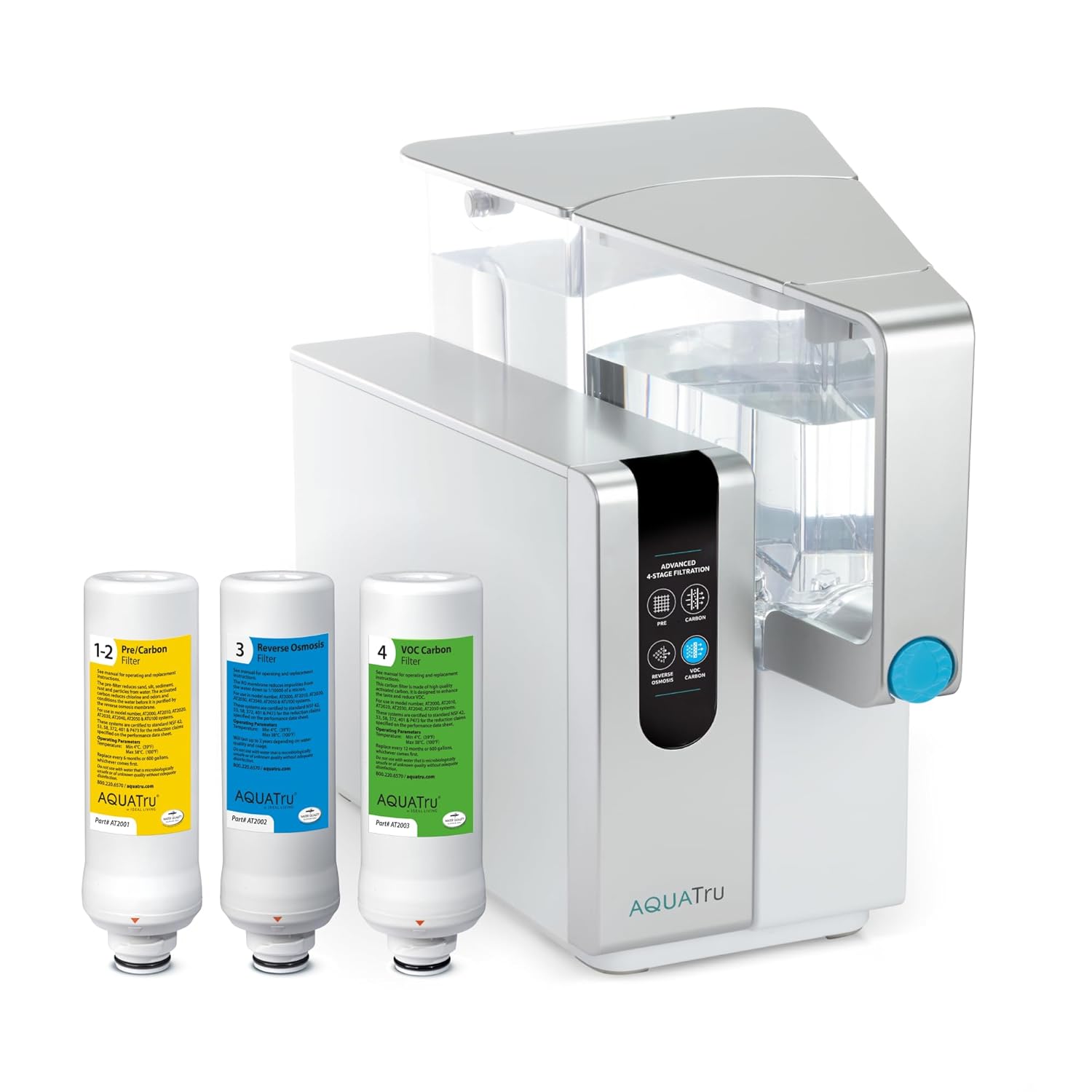
AquaTru Classic Countertop RO System
Check Price on Amazon →
Affiliate link — price may vary.

AquaTru Classic price in 2026

The AquaTru Classic retails at $449 through Amazon and AquaTru direct. Amazon is typically the same price or marginally cheaper and offers Prime shipping and easier returns — it's the better buy for most people.

Cost item Amount
Purchase price$449
Annual filter cost (Stage 1+2)~$60–70/yr
RO membrane (every 2 years)~$50/yr avg
Total annual running cost~$110–120/yr
5-year total cost of ownership~$1,000–1,050

For context: bottled water for one person costs roughly $600–900/year. The AquaTru Classic pays for itself in under a year for a household that currently buys bottled water. At $0.11–0.19 per gallon depending on filter life, it's significantly cheaper per gallon than any bottled alternative.

The AquaTru Alkaline model adds a fifth remineralization stage for $50 more ($499). The AquaTru Smart adds WiFi connectivity for $549. For most buyers the Classic at $449 is the right call — the Alkaline filter can be added later as an upgrade.

Check Current Price on Amazon — $449

Specs at a glance

Filtration type4-stage reverse osmosis (countertop)
Contaminants removed84 (NSF certified)
CertificationsNSF/ANSI 41, 53, 58, 401, P473 (via IAPMO)
Clean water tank capacity0.75 gallons
Tap water tank capacity1 gallon
Waste ratio0.6:1 (0.6 gallons wasted per gallon purified)
Installation requiredNone — countertop, plug-in
Power120V AC standard wall outlet
MaterialsBPA-free, BPS-free Tritan plastic
Stage 1–2 filter life6 months / 600 gallons
Stage 3 RO membrane life2 years / 1,200 gallons
Stage 4 VOC filter life12 months / 1,200 gallons
Annual filter cost (est.)$100–$120
Retail price$449

How we rate it

Filtration performance
5.0
Ease of use
4.5
Filter cost
4.5
Build quality
4.2
Value for money
4.4
Water waste
5.0

How the 4-stage filtration works

The AquaTru Classic uses a patented 4-stage process that AquaTru calls "Ultra Reverse Osmosis." Here's what each stage actually does:

Stage 1–2

Pre-Carbon Filter

Mechanical pre-filtration captures sediment, rust, and larger particles. Activated carbon then removes chlorine, chloramines, and improves taste and odor.

Replace every 6 months
Stage 3

RO Membrane

The core stage. An ultra-fine semi-permeable membrane removes lead, arsenic, fluoride, nitrates, chromium-6, microplastics, and other dissolved inorganics.

Replace every 2 years
Stage 4

VOC Carbon Filter

Coconut shell activated carbon removes volatile organic compounds including PFOA, PFOS (forever chemicals), prescription drug residue, and other organics. Final polish for taste.

Replace every 12 months

One thing worth noting: AquaTru uses an electric pressure pump to push water through the membrane, rather than relying solely on water pressure. This is what gives it that impressive 0.6:1 waste ratio — most gravity-fed or low-pressure RO systems waste considerably more.

What does the AquaTru Classic actually remove?

The AquaTru Classic is certified by IAPMO to NSF/ANSI standards 42, 53, 58, 401, and P473 — that's five separate certifications, which is more than any other countertop RO system we've reviewed. In practice, it removes:

84 contaminants total. For comparison, a standard Brita pitcher removes 30. The difference isn't subtle.

What it's like to actually use

Setup takes about 10 minutes. Unbox, run a flush cycle, and you're producing clean water. There's no plumber, no drilling under the sink, no waiting for an installation window. That alone is worth something to a lot of people.

Day-to-day, you fill the 1-gallon tap water tank at the back, and the system produces purified water into the 0.75-gallon clean water tank at the front. A one-touch button dispenses water. The filter life indicator on the front panel lights up when a specific filter needs replacement — no guessing or calendar reminders required.

The 0.75-gallon tank is the main practical limitation. For a single person or couple, it's rarely an issue. For a family of four or five that drinks a lot of water, cooks with it, and fills a pet bowl — you'll be refilling the tap tank more frequently than you might expect. It's not a dealbreaker, but it's honest to mention.

Taste-wise, the water is noticeably cleaner than tap or even pitcher-filtered water. The VOC stage in particular makes a real difference — the flat, chemical-free taste that RO water produces is something people either love immediately or need a day to adjust to.

Filter replacement costs — the real annual number

This is where AquaTru actually shines compared to competitors. Here's the full replacement schedule for the Classic:

Stage 1–2 Pre-Carbon FilterEvery 6 months / 600 gallons
Stage 3 RO MembraneEvery 2 years / 1,200 gallons
Stage 4 VOC Carbon FilterEvery 12 months / 1,200 gallons

Because the RO membrane only needs replacing every two years, your annual cost works out to roughly $100–$120 per year — below average for a certified countertop RO system. The filter life indicator means you're not replacing things early out of guesswork.

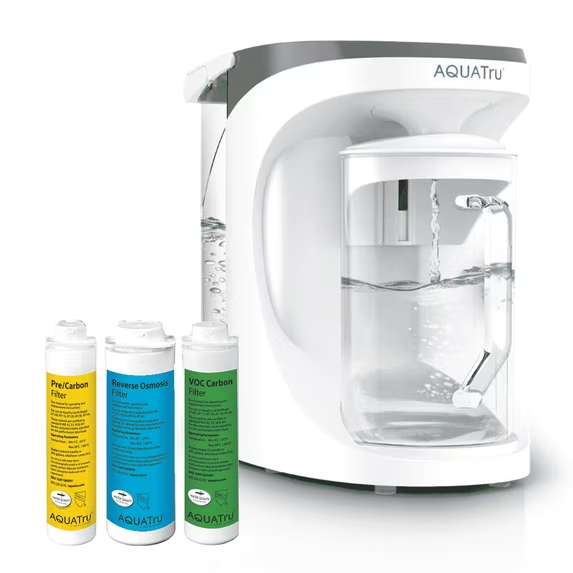
One important note: the AquaTru Classic uses different filters from the Carafe model. They're not interchangeable. If you ever upgrade to or add a Carafe, buy the right filter set for each unit.

For the full breakdown of what to buy and when, see our AquaTru Classic filter replacement guide.

Classic vs Classic Smart vs Alkaline — which version?

AquaTru now sells the Classic in three configurations:

For most people the standard Classic is the right call. If alkaline water is a priority for you, the Alkaline version is a clean upgrade. The Smart version is genuinely useful if you tend to forget filter changes.

Inlet water limits — the gate most buyers skip

The manual publishes six thresholds. Exceed any of them and you're outside the design envelope — the membrane can clog, the system can underperform, or the warranty can be affected. Test your water before spending $449.

ParameterLimitWhy it matters
Total dissolved solids1,500 mg/L maxReduced performance above this; membrane working beyond design load
Hardness10 gpg (171 mg/L) maxScale plugs the RO membrane — see the callout below
Iron, manganese, sulphideUnder 0.1 mg/L eachFouling — common in well water and some groundwater
ChlorineUnder 2 ppmChlorine damages RO membranes; the carbon pre-filter protects it
pH3–11Outside this range the materials are out of specification
Turbidity5 NTU maxCloudiness will load the pre-filter rapidly and shorten its life

The hardness limit is the one that catches people

The manual states: if hardness is above 10 gpg, lime scale will build up rapidly on the membrane inside the RO cartridge, scale build-up will plug the cartridge and make the system ineffective, and AquaTru is not recommended for use above that hardness unless the water is softened first. Ten grains per gallon is not exotic — large parts of the Midwest, Southwest, and limestone regions routinely exceed it. A hardness test strip costs a few dollars. Do it before you spend $449, not after the membrane clogs.

Well water: The manual requires a municipally treated or known microbiologically safe supply. Well water often contains iron, sediment, bacteria, or hardness at concentrations that will clog or damage the membrane. Whole-house filtration with UV disinfection should come first, with the AquaTru as a final polishing step — not as primary treatment.

The tap-tank rule — the most important operational note in the manual

Discard all leftover tap water every single time you refill — or the warranty is void

The manual states this four times: in installation, in daily use, in troubleshooting, and as a standalone warning. The troubleshooting table is explicit — under the symptom of the top circle being illuminated, the stated cause is that you did not remove the tap water tank when you refilled it, and the stated consequence is that the warranty is void and the unit will stop filtering water. Tell everyone in the household. This is not boilerplate — the manual attaches a specific warranty consequence to it.

1️⃣

Top circle illuminates — the system signals the tap tank is done. Do not add more water to it yet.

2️⃣

Remove the tap tank completely — carry it to the sink.

3️⃣

Discard whatever water remains — all of it. Don't top up.

4️⃣

Refill with fresh tap water and replace the tank.

What to expect from a TDS meter — the manual is honest

Under the troubleshooting entry for higher-than-expected TDS readings, the manual states plainly: RO systems generally lower TDS readings by 90% compared to tap water readings. That is a realistic and notably modest figure — several other products in this category claim 99.9% in marketing while their manuals say nothing specific. If you buy a TDS meter and see a 90% reduction, the system is working as documented. The manual also recommends testing product water periodically to verify the system is performing properly.

What 90% looks like in practice: If your tap water reads 300 ppm TDS, expect the AquaTru output to read around 30 ppm. If your tap reads 500 ppm, expect around 50 ppm. A membrane approaching end of life will show a reduced rejection rate — track the number over time, not just once.

Maintenance schedule — from the owner's manual

WhenTask
Every refillRemove tap tank, discard remaining water, refill fresh — warranty condition
First use / new filtersRun four full tanks of unfiltered water through and discard — do not drink
WeeklyWash both tanks with soap and water; flush the spout and bottom valves. Hand wash only — not dishwasher safe.
WeeklyWipe exterior with non-abrasive sponge, dry thoroughly
As illuminatedReplace the indicated filter. Wait 60 seconds after removing the cover before removing the filter. Press the rear reset button after replacement.
After new VOC filterRun four full tap tanks through to rinse out carbon particles before drinking
When scale appearsSoak tank in 1:1 vinegar and water for at least 3 hours, then rinse thoroughly
PeriodicallyTest product water TDS — manual says to do this to verify performance
Returning from holidayWash and dry both tanks, run four full tanks to purge stagnant water before drinking

Common mistakes to avoid

Topping up the tap tank without emptying it first

The manual attaches a warranty consequence to this. Remove, discard, refill — every time, without exception.

Not checking hardness before buying

The 10 gpg ceiling is non-negotiable per the manual. A hardness test strip costs a few dollars — do it before spending $449.

Skipping the four-tank startup flush

New carbon media releases fine particles. Four full tanks of unfiltered water before drinking, every time filters are replaced.

Putting the tanks in the dishwasher

The manual explicitly says hand wash only. Dishwasher heat can warp the tanks.

Expecting 99% TDS reduction and using a meter to "test" it

The manual says RO generally lowers TDS by about 90%. Track the number over time — a rising trend means the membrane needs attention.

Panicking at the white cloud in the tap tank or micro-bubbles in clean water

Both are explicitly described as normal in the manual — the white cloud during filter saturation may occur during every use.

Forgetting the reset button after a filter change

The filter indicator stays on until you press the reset button on the rear of the unit. A lit indicator after a new filter is almost always a forgotten reset, not a defective cartridge.

Using filtered water for an aquarium

Explicitly warned against in the manual — RO water lacks the minerals fish require.

Placing it beside the stove, microwave, or oven

Both heat and direct sunlight are explicitly prohibited. Level surface, out of direct sun, away from hot appliances.

Who should buy the AquaTru Classic?

✓ Good fit if you...

  • Rent and can't install under-sink plumbing
  • Want the best countertop RO filtration available
  • Have a household of 1–4 people
  • Are concerned about PFAS, lead, or fluoride specifically
  • Want low ongoing maintenance costs
  • Currently spending money on bottled water

✗ Look elsewhere if you...

  • Have water hardness above 10 gpg — test first, the manual is explicit
  • Are on private well water — requires municipally treated supply
  • Have a large family with very high water demand
  • Want to avoid all plastic in your water contact
  • Are on a tight budget — the upfront cost is real
  • Have very limited counter space
  • Only need chlorine taste removed — a pitcher filter costs $30–80

Final verdict

The AquaTru Classic is genuinely the best countertop reverse osmosis system available right now. The NSF certifications aren't marketing — they're independent third-party verification that this thing removes what it claims to remove. The waste ratio is impressive for a countertop unit. The filter costs are reasonable. And the zero-installation setup is a genuine advantage for anyone renting or who simply doesn't want to touch their plumbing.

The $449 price tag will give some people pause, and fairly. But if you're spending $30–50 a month on bottled water, the AquaTru Classic pays for itself in under a year — and produces water that's actually cleaner than most bottled brands. For the right household, it's an easy recommendation.

AquaTru Classic Countertop RO System
Check Price on Amazon →
Affiliate link — price may vary.

PFAS Removal — Non-Detect Results Confirmed

PFAS (per- and polyfluoroalkyl substances), also known as forever chemicals, are among the most challenging contaminants to remove from drinking water. The AquaTru Classic is the only countertop RO system independently confirmed to reduce all PFAS analytes to Non-Detect levels through Tap Score laboratory testing.

INDEPENDENT TAP SCORE LAB RESULTS — PFAS PANEL
Untreated tap water
PFOA: Detected
PFOS: Detected
12 additional PFAS analytes: Detected
After AquaTru Classic
PFOA: Non-Detect
PFOS: Non-Detect
All 14 PFAS analytes: Non-Detect
Source: Quality Water Lab independent Tap Score testing on a 3+ year in-use unit. Non-Detect = below the analytical detection threshold.

This result was achieved on a system that had been in real-world use for over three years — not a new system tested under controlled lab conditions. That distinction matters: it means the PFAS removal performance holds through normal aging and filter cycling, not just out of the box.

0.6:1 Waste Ratio — Far Better Than Under-Sink RO

The AquaTru Classic wastes approximately 0.6 gallons for every 1 gallon purified — a fraction of the 3:1 to 5:1 waste ratios typical of under-sink RO systems. This efficiency comes from the recirculation design: water in the tap tank passes through the RO membrane multiple times, concentrating contaminants in the tap tank while maximizing the volume of purified water produced.

Always discard residual tap water before refilling. The tap water tank accumulates concentrated contaminants during the recirculation process. Before refilling with fresh tap water, always empty and discard whatever remains. Per AquaTru Europe’s FAQ, failing to discard residual tap water can void the warranty.

Filter Part Numbers & Replacement Schedule

FilterPart NumberReplace EveryOr Gallons
Pre/Carbon Composite (Stages 1–2)10AT022SF016 months300 gallons
RO Membrane (Stage 3)10AT02ROF0124 months600 gallons
VOC Carbon Filter (Stage 4)10AT02VF0112 months300 gallons
Classic filters are NOT compatible with the Carafe model. The Carafe uses different filter dimensions and part numbers. Always verify model before ordering. The Classic, Classic Smart, and Under Sink models share the same filter set.
Alkaline filter break-in period: If upgrading to the optional Mineral Alkaline VOC Filter variant, expect an unusual taste for the first 12–15 full tank flush cycles. This is normal for new remineralization media and clears completely with flushing. Do not assume the filter is defective during this break-in period.

Frequently asked questions

The AquaTru Classic retails at $449 as of May 2026. Annual filter costs run $100–120/year (Stage 1+2 filters plus the RO membrane amortized over two years). The 5-year total cost of ownership is approximately $1,000–1,050. Amazon is the best place to buy — same price as AquaTru direct with Prime shipping and easier returns.
No. The AquaTru Classic sits on your countertop, plugs into a standard 120V outlet, and requires no plumbing connection. You fill the tap water tank manually and the system does the rest. Setup takes about 10 minutes including the initial flush cycle.
Annual filter replacement costs run approximately $100–$120 per year. This is below average for a certified countertop RO system. The RO membrane only needs replacing every 2 years, which keeps the ongoing cost manageable compared to systems that require more frequent full filter changes.
The AquaTru Classic wastes about 0.6 gallons for every 1 gallon of purified water it produces. This 0.6:1 waste ratio is significantly better than traditional under-sink RO systems, which typically waste 3–5 gallons per gallon purified. AquaTru achieves this because it uses an electric pressure pump rather than relying solely on household water pressure.
The AquaTru Classic is certified to remove 84 contaminants including lead, fluoride, chlorine, arsenic, nitrates, chromium-6, PFOA, PFOS, microplastics, and VOCs. It is independently certified by IAPMO to NSF/ANSI standards 42, 53, 58, 401, and P473 — five certifications, more than any other countertop RO we've reviewed.
The Classic has a larger 0.75-gallon plastic clean water tank and is better for families or higher daily water use. The Carafe uses a smaller 0.5-gallon glass carafe, is more compact, and suits singles or couples better. The two models use completely different filters — they are not interchangeable. See our full AquaTru Carafe vs Classic comparison for a detailed breakdown.
It depends on your water quality and what you're trying to remove. A Brita pitcher removes roughly 30 contaminants, primarily chlorine and some heavy metals. The AquaTru removes 84 contaminants, including fluoride, PFAS compounds, and microplastics that pitcher filters cannot touch. If you have concerns about PFAS, lead, fluoride, or other serious contaminants, the AquaTru is a fundamentally different class of product — not just a more expensive Brita.