The best value under-sink RO system on the market
The iSpring RCC7AK delivers 6-stage filtration with alkaline remineralization at a price that's hard to argue with. NSF 58 certified for the entire system — not just components — it removes 1,000+ contaminants including fluoride, lead, arsenic, and PFAS at 96–99%. The alkaline stage produces genuinely better-tasting water than standard 5-stage RO. Installation takes 2–3 hours and is DIY-friendly with iSpring's excellent video guides. The tank takes up under-sink space and the 1:3 waste ratio is typical for tank-based RO — but neither is a dealbreaker for what you get.
- NSF/ANSI 58 certified — entire system, not just components
- 6-stage with alkaline remineralization — great-tasting water
- 75 GPD — fast enough for any household
- 18,000+ Amazon reviews, 4.6-star average
- Lifetime technical support from Alpharetta, GA
- Transparent first-stage housing to see filter condition
- Excellent filter replacement value (1-year set available)
- Patented top-mounted faucet — easier installation
✓ What we like
- Requires installation — not plug-and-play like countertop RO
- 3.2-gallon tank takes up under-sink cabinet space
- 1:3 waste ratio — standard for tank-based RO
- Needs 45+ PSI water pressure (most homes are fine)
- PFAS reduction is 96–99% — excellent, but not 100%
✗ What to know
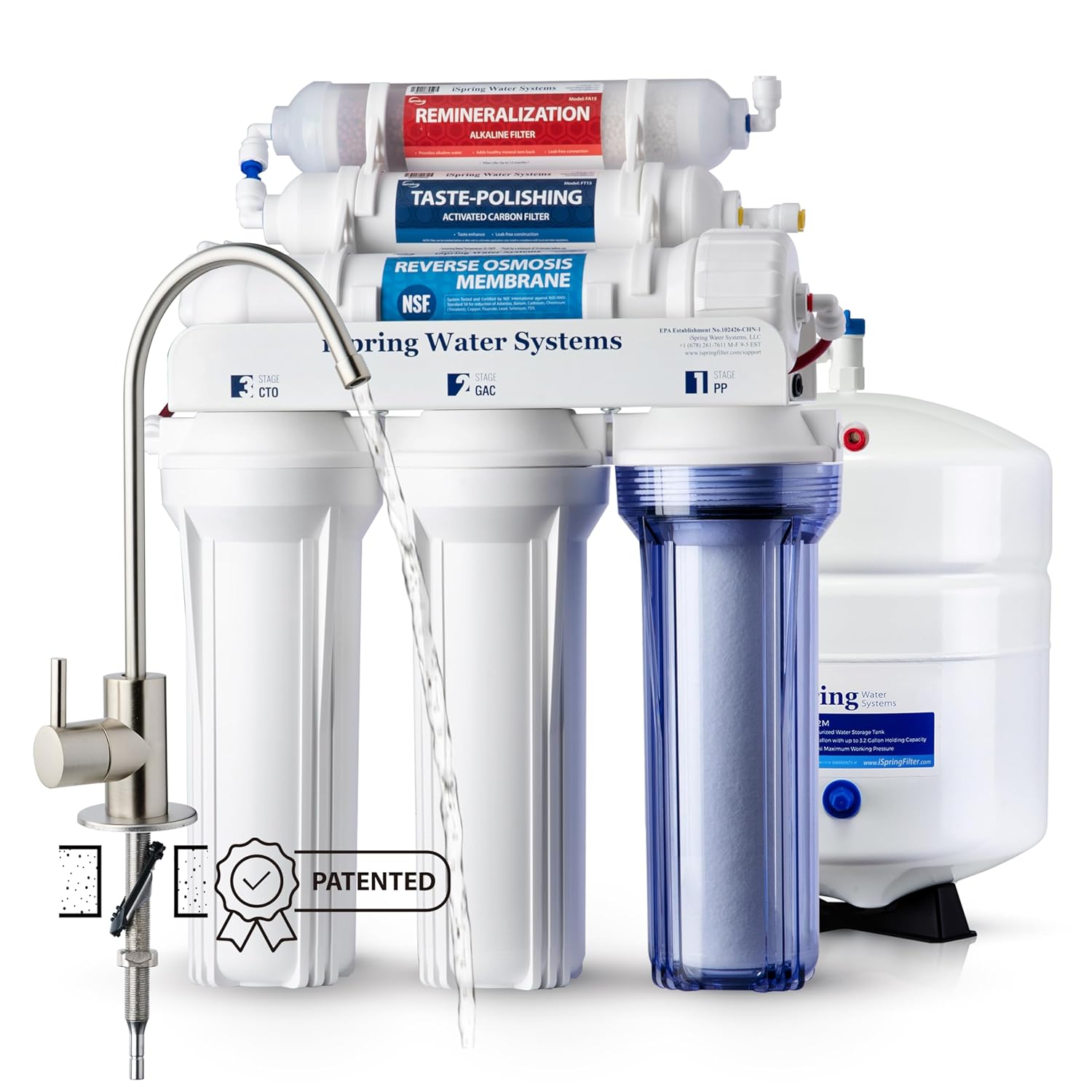
Specs at a glance
| Filtration stages | 6-stage (sediment, GAC, CTO, RO membrane, post-carbon, alkaline) |
| Contaminants removed | 1,000+ (NSF 58 certified) |
| Certifications | NSF/ANSI 58, NSF/ANSI 372 (full system) |
| Flow rate | 75 GPD (gallons per day) |
| Storage tank | 3.2 gallons (pressurized, included) |
| Waste ratio | ~1:3 (3 gallons wasted per gallon purified) |
| Minimum water pressure | 45 PSI (most homes: 60–80 PSI) |
| Installation type | Under sink — DIY-friendly, 2–3 hours |
| Faucet included | Yes — brushed nickel, top-mounted design |
| TDS reduction | 93–98% |
| Lead reduction | 98.9%+ |
| Fluoride reduction | 97.4%+ |
| PFAS reduction | 96–99% |
| Annual filter cost (est.) | $60–$100 depending on set chosen |
| Warranty | 1-year + lifetime technical support |
How we rate it
The 6-stage filtration process
Most under-sink RO systems stop at 5 stages. The RCC7AK goes to 6 — and the extra stage is the one that makes the biggest difference to daily use.
PP Sediment
Removes sediment, rust, sand, dust, and large particles. Transparent housing lets you see buildup — you know exactly when to replace it.
Granular Carbon (GAC)
Removes chlorine, cloudiness, bad taste, and odors. First carbon stage protects the RO membrane from chlorine damage.
Carbon Block (CTO)
Second carbon stage provides extra protection against organic chemicals. Dual carbon stages set RCC7AK apart from single-carbon competitors.
RO Membrane
The core stage. 0.0001-micron membrane removes lead, fluoride, arsenic, nitrates, PFAS, chromium, and 1,000+ dissolved contaminants.
Post-Carbon (GAC)
Final carbon polishing stage improves taste and removes any remaining odors before water reaches the tank.
Alkaline (AK)
The differentiator. Restores calcium, magnesium, and potassium removed by the RO membrane. Raises pH for natural-tasting, mineralized water.
The dual carbon stages (GAC + CTO in stages 2–3) give the RCC7AK stronger pre-membrane protection than systems using a single carbon filter. This extends RO membrane life and provides more complete removal of organic chemicals.
Real-world filtration performance
NSF 58 certification covers the complete system — iSpring is one of the few brands that certifies the full assembly rather than individual components. The numbers are strong across the board:
- TDS reduction: 93–98% — Starting from typical municipal water at 200–400 TDS, output runs 10–30 TDS
- Lead: 98.9%+ — Effectively eliminates lead from aging pipes
- Fluoride: 97.4%+ — One of the most effective fluoride reducers in its class
- PFAS: 96–99% — Strong performance, though some competitors reach 100% on specific PFAS subtypes
- Asbestos: 99.7%+
- Arsenic, Chromium, Barium, Cadmium: 98%+
The one honest caveat: independent testing showed PFNA (a specific PFAS subtype) reduction at approximately 90% rather than the 96–99% overall PFAS figure. For most households this is immaterial. If PFNA specifically is a documented concern in your area, it's worth noting.
The alkaline stage — is it worth it?
Standard 5-stage RO water is slightly acidic (pH 6.5–7.0) and lacks the minerals naturally present in spring water. Some people find it tastes flat. The RCC7AK's alkaline stage adds calcium, magnesium, and potassium back in, raising pH to a more natural 7.5–8.0 range.
This isn't marketing fluff — the difference is real and noticeable. Users who switch from the standard RCC7 to the RCC7AK consistently report preferring the taste. iSpring charges a modest premium for this stage, and it's consistently cited as worth the upgrade in long-term owner reviews.
Installation: honest assessment
Under-sink installation is the main reason some people choose countertop RO over the RCC7AK. Let's be honest about what's involved:
- Connect to the cold water supply line under the sink (shut-off valve included)
- Connect the drain line to the sink drain pipe
- Drill a hole in the countertop or sink for the dedicated faucet (most sinks have a pre-drilled hole)
- Connect the storage tank
- Mount the filter housing assembly under the sink
iSpring's patented top-mounted faucet design is a genuine help here — you tighten the faucet nut from above rather than reaching underneath the sink. The included video guides are among the best in the industry. Most handy homeowners complete this in 2–3 hours on the first attempt.
If you rent, can't drill, or genuinely don't want to touch plumbing — look at the AquaTru Classic instead. Otherwise, the RCC7AK installation is manageable.
Filter replacement costs
iSpring sells replacement sets by duration, which makes budgeting simple:
| F4AK — 6-month set | Pre-filters + alkaline filter |
| F9K — 1-year set | Most popular — includes all filters for 12 months |
| F19K75 — 2-year set | Best per-filter value, includes RO membrane replacement |
| F28K75 — 3-year set | Lowest per-filter cost, stock up and save |
| Annual cost estimate | $60–$100 depending on set chosen |
The RO membrane typically lasts 2–3 years. Pre-filters (sediment and carbon) need replacing every 6–12 months. The 1-year set (F9K) is the most practical for most households — everything you need in one order, once a year.
See our full iSpring RCC7AK filter replacement guide for the complete schedule and what to buy.
RCC7AK vs the standard RCC7
If you're deciding between the two iSpring models, the choice is straightforward: the RCC7AK is worth the upgrade for almost everyone. The alkaline stage is the only meaningful difference — same RO membrane, same certifications, same installation. The RCC7 produces slightly acidic, mineral-free water. The RCC7AK produces naturally balanced, mineralized water that simply tastes better.
The price difference is typically $20–$40. Given the daily quality-of-life improvement, it's rarely worth saving on. See our full iSpring RCC7 vs RCC7AK comparison for the detailed breakdown.
Who should buy the iSpring RCC7AK?
✓ Good fit if you...
- Own your home or have landlord permission to install
- Want the best filtration per dollar spent
- Have concerns about lead, fluoride, arsenic, or PFAS
- Want on-demand water without refilling a tank
- Value great-tasting water with natural minerals
- Want lifetime technical support
✗ Look elsewhere if you...
- Rent and can't install under-sink plumbing
- Have water pressure below 45 PSI (use RCC7P-AK instead)
- Want zero installation — consider countertop RO
- Have very limited under-sink cabinet space
Final verdict
The iSpring RCC7AK earns its position as America's best-selling under-sink RO system. At its price point, nothing else delivers this combination: full NSF 58 system certification, 6-stage filtration with alkaline remineralization, 75 GPD flow rate, excellent filter costs, and lifetime technical support. The 18,000+ Amazon reviews aren't a fluke — this system has been proving itself in real homes for years.
If you own your home and want the best under-sink RO value available, this is it. We'd recommend it without hesitation to anyone who's comfortable with basic DIY installation.
Filter Part Numbers & Schedule — Complete Reference
| Stage | Filter | Part No. | Replace Every |
|---|---|---|---|
| 1 | Sediment (5 micron) | FP15 | 6 months |
| 2 | GAC Carbon | FG15 | 6 months |
| 3 | Carbon Block | FC15 | 6 months |
| 4 | RO Membrane | MC7 | 2–3 years |
| 5 | Post Carbon (inline) | FT15 | 12 months |
| 6 | Alkaline Remineralization | FA15 | 6 months |
Filter packs: F9K (1-year) | F19K75 (2-year) | F28K75 (3-year). Available at 123filter.com, Amazon, and Home Depot.
Performance Monitoring & Maintenance Tips
TDS Rejection Formula
Example: Tap = 300 ppm, RO = 18 ppm → [1 − (18÷300)] × 100 = 94%
Tank Pressure Check
An empty RCC7AK storage tank should read 7–10 PSI. Use a standard tire gauge on the air nozzle at the bottom of the tank. Add air with a bicycle pump if low; release air slowly if above 10 PSI. Check periodically — low tank pressure is the most common cause of slow flow at the faucet when pre-filters and the membrane are otherwise healthy.
Vacation Prep
Trips longer than one week: Also remove the RO membrane (Stage 4) and store it in a damp Ziploc bag in the refrigerator. A dry membrane cracks and loses rejection performance permanently.
Installation — Key Steps & Common Mistakes
Full installation takes 1–2 hours. Tools needed: variable-speed drill with 1/4" and 1/2" bits, adjustable wrench, pliers, Phillips screwdriver, utility knife.
Troubleshooting Reference
| Symptom | Cause | Fix |
|---|---|---|
| System drains continuously | Feed pressure below 45 PSI | Install booster pump. Do not adjust pressure switch. |
| No water at faucet | Supply valve off; kinked tubing; tank valve closed | Verify supply valve open; trace all tubing for kinks; confirm tank valve is open and aligned with yellow tubing. |
| Leaking at tubing connections | Tubing not pushed in far enough (needs 5/8" past O-ring) | Push tubing in firmly until you feel it pass the O-ring. If O-ring damaged, replace fitting with included spare using Teflon tape on threads. |
| Leaking at membrane cap | O-ring seated incorrectly (inside threads instead of before threads) | Remove cap, reposition O-ring onto the membrane housing end before the threads begin, reinstall cap. |
| Cloudy water | Air bubbles from new filters | Normal and harmless. Clears within a few cycles as trapped air purges. |
| TDS rejection below 90% | Membrane needs replacement or is being bypassed | Replace Stage 4 membrane (MC7). If replacing doesn’t help, contact iSpring support at (678) 261-7611. |
Keep reading
- iSpring RCC7 vs RCC7AK — is the alkaline stage worth it?
- iSpring RCC7 review — the 5-stage base model
- iSpring RCC7AK replacement filter guide
- How to install the iSpring RCC7AK
- iSpring vs APEC — which under-sink RO wins?