UV + pressure gauge at $349.99 is a strong package — buy the T1-400ALK for daily drinking water
The T1-400 lineup offers something genuinely uncommon at this price point: built-in UV sterilization and an analog pressure gauge on an 8-stage 400 GPD tankless under-sink system. UV sterilization handles bacteria and viruses the RO membrane may miss; the pressure gauge lets you verify the system is operating correctly without guesswork. Both variants are identically priced at $349.99. The T1-400ALK swaps the post-carbon stage for an alkaline filter — for daily drinking water that's the right call. The standard T1-400 is for buyers who specifically want near-zero TDS output.
- UV sterilization included — rare at this price
- Analog pressure gauge — diagnose issues early
- Boost pump included — consistent pressure output
- T1-400ALK: 5.0 stars across 136 reviews
- T1-400: 4.9 stars across 129 reviews
- NSF/ANSI 58 certified (SGS tested)
- 12% Awin commission — $42 per sale
✓ What we like
- 400 GPD — lower than Q3-600's 600 GPD
- NSF 58 only — no NSF 42 or 401
- Larger physical footprint than compact tankless systems
- Shopify-based brand with shorter US track record
✗ What to know
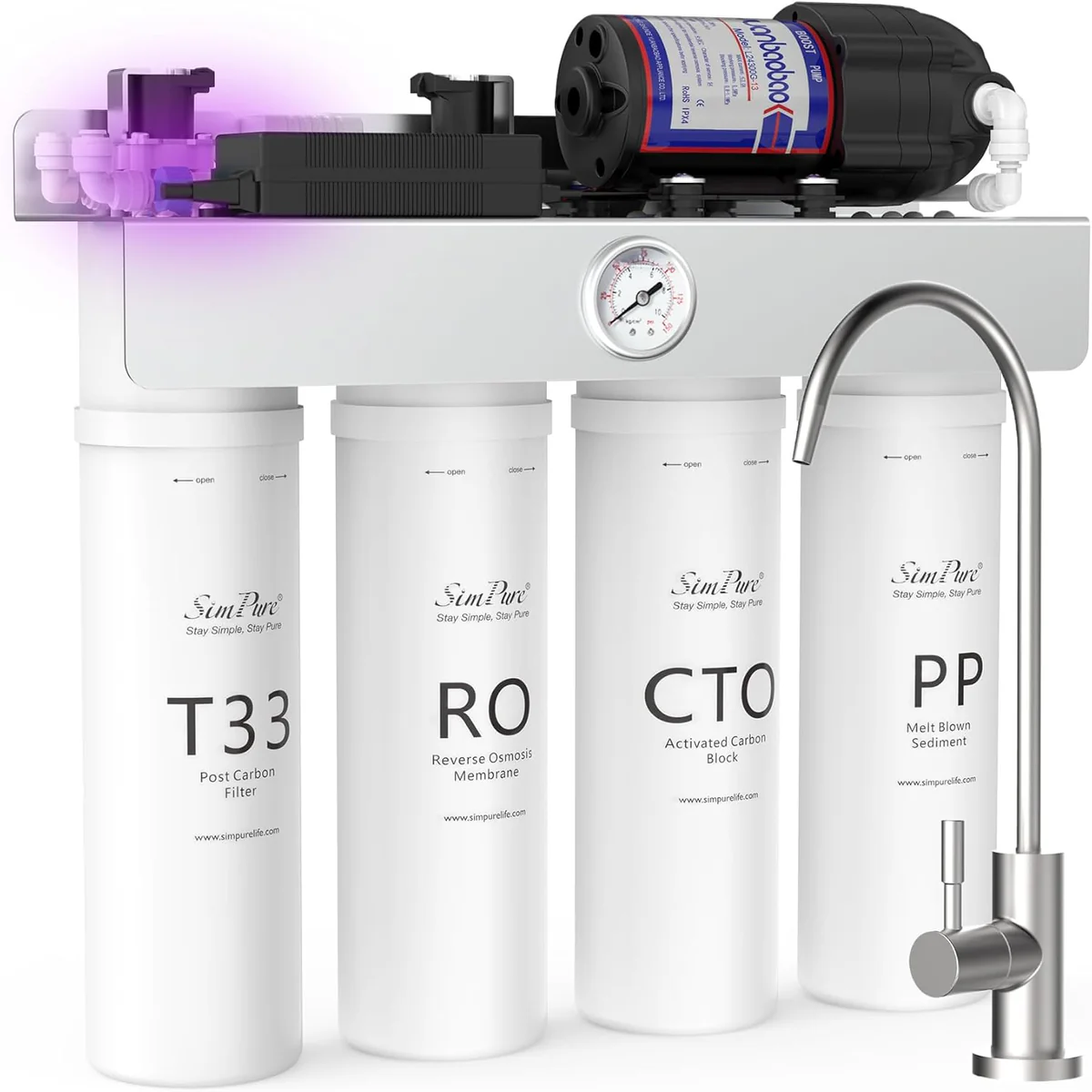
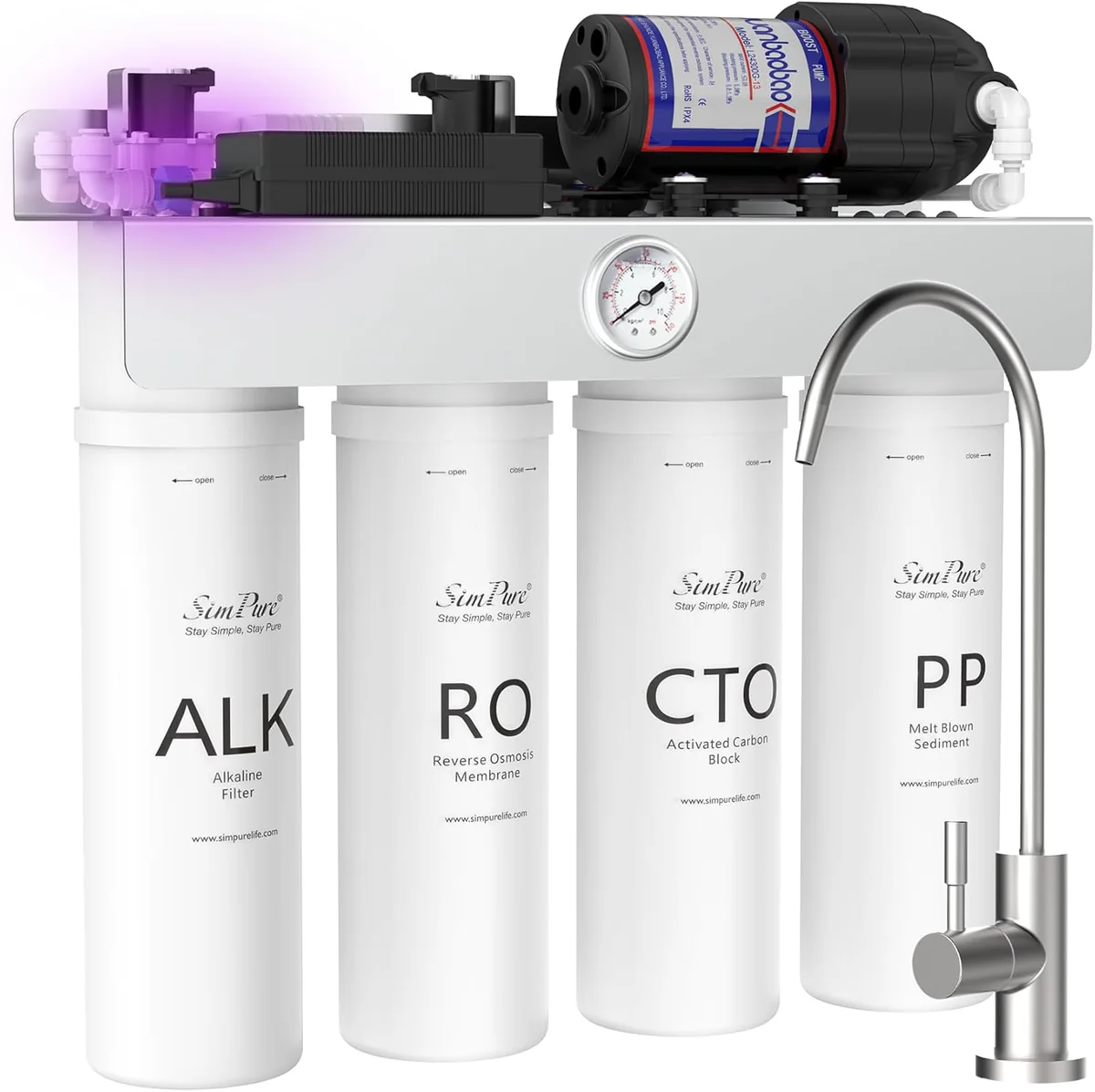
Specs at a Glance
| Spec | T1-400 | T1-400ALK |
|---|---|---|
| Price | $349.99 | $349.99 |
| Stages | 8 | 8 |
| Flow Rate | 400 GPD | 400 GPD |
| Tank | Tankless | Tankless |
| UV Sterilization | ✓ | ✓ |
| Pressure Gauge | ✓ | ✓ |
| Boost Pump | ✓ | ✓ |
| Remineralization | ✗ (near 0 TDS) | ✓ ALK stage |
| Certification | NSF/ANSI 58 | NSF/ANSI 58 |
| Amazon Rating | 4.9 ★ (129) | 5.0 ★ (136) |
| Commission | 12% (Awin) | 12% (Awin) |
The UV and Pressure Gauge Difference
These two features set the T1-400 lineup apart from most under-sink RO systems at this price point and are worth understanding before buying.
UV sterilization: The RO membrane removes dissolved contaminants extremely effectively — lead, fluoride, nitrates, PFAS — but it doesn't guarantee elimination of all microorganisms. UV light inactivates bacteria, viruses, and protozoa by disrupting their DNA. On municipal water, where bacteria are controlled by chlorination, UV adds a redundant safety layer. On well water, where bacterial contamination is a real concern, UV sterilization is a meaningful upgrade. Most under-sink RO systems at $350 don't include UV — it's typically a separate add-on or found only on premium systems.
Pressure gauge: The analog gauge mounted to the bracket shows the water pressure entering the system. RO membranes perform optimally between 40–80 PSI. Below 40 PSI, output rate drops and membrane efficiency suffers. Above 80 PSI, seals and tubing can fail. Most systems give you no indication of operating pressure — you find out something's wrong when flow rate drops or water quality changes. The gauge lets you see problems coming before they affect performance. Only one other system in our reviews includes this feature: the GlacierFresh U03.
T1-400 vs T1-400ALK: Same Price, Different Output
Unlike the Q3-600 vs Q3-600A decision where one costs $5 more, both T1-400 variants are identically priced. The choice is purely about what you want the output water to taste and measure like.
The T1-400 uses a T33 post-carbon filter as its first stage, designed for near-zero TDS output — the purest water the system can produce with minimal dissolved solids remaining. That's ideal for: aquariums and fish tanks, steam irons and humidifiers (mineral buildup is avoided), lab or specialty applications, or buyers who specifically prefer the cleanest possible filtration.
The T1-400ALK replaces T33 with an ALK alkaline filter that adds calcium and magnesium back after the RO membrane. The output has a slightly higher TDS and pH, and tastes more like natural mineral water than pure RO output. For daily drinking water — the primary use case for most buyers — the T1-400ALK produces water most people will prefer to drink straight.
Both have identical UV sterilization, pressure gauge, boost pump, and NSF 58 certification. The 5.0-star rating on the T1-400ALK (136 reviews) vs 4.9 on the standard (129 reviews) is another small signal in favor of the ALK variant.
What It Removes
- PP melt-blown sediment — particles, rust, and turbidity
- CTO activated carbon block — chlorine, chloramines, VOCs, taste and odor
- RO membrane (NSF/ANSI 58) — lead, arsenic, nitrates, fluoride, PFAS, heavy metals, dissolved inorganics (90–97% removal)
- T33 post-carbon (T1-400) — final taste polish, maintains near-zero TDS
- ALK alkaline filter (T1-400ALK) — adds calcium/magnesium, raises pH
- UV sterilization — inactivates bacteria, viruses, microorganisms
- Boost pump — maintains optimal RO membrane pressure
Both models remove fluoride at the RO membrane stage. See: Does reverse osmosis remove fluoride?
How It Compares to the Competition
| Feature | T1-400ALK ($350) | Q3-600A ($335) | Waterdrop G3P800 ($399) |
|---|---|---|---|
| Flow rate | 400 GPD | 600 GPD | 800 GPD |
| UV sterilization | ✓ | ✗ | ✗ |
| Pressure gauge | ✓ | ✗ | ✗ |
| Remineralization | ✓ ALK | ✓ ALK | ✗ |
| NSF 58 | ✓ | ✓ | ✓ |
| NSF 42 / 401 | ✗ | ✗ | ✓ |
| Best for | UV + alkaline combo | Higher GPD + alkaline | Max certifications |
The T1-400ALK's unique position: it's the only under-sink system in this comparison with UV sterilization and alkaline remineralization in one package. If either of those features matters to you, neither the Q3-600A nor the Waterdrop G3P800 delivers both. The tradeoff is the lower GPD (400 vs 600 or 800) and narrower NSF certification scope.
Who Should Buy the T1-400
Buy the T1-400ALK if: you want UV sterilization for peace of mind on well water or aging municipal systems, you value a pressure gauge for system monitoring, and you want alkaline remineralized drinking water. It's the most feature-complete system in SimPure's under-sink lineup.
Buy the standard T1-400 if: you specifically need near-zero TDS output — aquariums, humidifiers, steam appliances, or any application where mineral content causes problems.
Consider the SimPure Q3-600A instead if: you need higher flow rate (600 GPD) and UV sterilization is less of a priority. At $335 it's slightly cheaper with 50% more GPD.
Consider Waterdrop G3P800 instead if: NSF 42 and 401 certifications are a firm requirement. Waterdrop has broader certification coverage and a larger review base.