Does Reverse Osmosis Remove Fluoride?
Updated May 2026 · 8 min read
Short answer: Yes.
Reverse osmosis removes 90–96% of fluoride from drinking water. The semi-permeable RO membrane rejects fluoride ions as part of normal operation — no special setup or add-on cartridge required. All RO systems using a genuine thin-film composite (TFC) membrane achieve this range. NSF/ANSI 58 certification independently verifies this performance.
Fluoride is one of the most searched contaminants for home water filtration — and one of the most misunderstood. Most people are surprised to learn that common filters like Brita pitchers and refrigerator cartridges don't remove fluoride at all. Reverse osmosis does, reliably, and the removal rate is high enough to matter at every realistic tap water concentration.
This page covers how RO removes fluoride, how much it actually removes, which systems are NSF certified to do it, and what to avoid if fluoride removal is your goal.
How Reverse Osmosis Removes Fluoride
The RO membrane is the core of every reverse osmosis system. It's a sheet of semi-permeable material with pores approximately 0.0001 microns wide — small enough to block dissolved ions like fluoride while allowing water molecules to pass through.
Fluoride exists in water as the fluoride ion (F⁻), a negatively charged particle. The RO membrane rejects it through two mechanisms:
- Size exclusion — Fluoride ions are larger than water molecules. The membrane's microscopic pore structure physically blocks their passage while water flows through.
- Charge repulsion — The membrane surface carries a slight negative charge, which repels negatively charged fluoride ions, adding a second layer of rejection beyond simple size filtering.
The rejected fluoride is flushed away with the wastewater stream — the water that drains during filtration. This is why RO systems produce some wastewater: it's carrying the contaminants that didn't pass through the membrane.
You don't need any special media or add-on cartridge to remove fluoride with an RO system. The membrane handles it as part of normal operation. This is one of the reasons RO is considered the most reliable home method for fluoride reduction.
How Much Fluoride Does RO Remove?
Most RO systems remove between 90% and 96% of fluoride. Three factors determine the exact percentage:
- Membrane quality — Higher-grade thin-film composite membranes achieve closer to 95–99% rejection.
- Feed water pressure — Higher pressure improves membrane performance. Below 40 PSI, rejection rates drop. Tankless systems with built-in booster pumps maintain consistent pressure regardless of incoming supply.
- Membrane age — A worn membrane loses rejection capability. Replacing the RO membrane every 2–3 years maintains rated performance.
Fluoride reduction at common tap levels
| Feed water (PPM) | After 90% removal | After 95% removal | After 99% removal |
|---|---|---|---|
| 0.7 PPM (US standard) | 0.07 PPM | 0.035 PPM | 0.007 PPM |
| 1.5 PPM (high municipal) | 0.15 PPM | 0.075 PPM | 0.015 PPM |
| 4.0 PPM (high well water) | 0.40 PPM | 0.20 PPM | 0.04 PPM |
For well water with naturally occurring fluoride above 4 PPM, a higher-rejection membrane or pre-treatment stage may be warranted. For the vast majority of city water users at 0.7 PPM, any NSF 58-certified RO system brings output to negligible levels.
NSF/ANSI 58 Certification for Fluoride
NSF/ANSI 58 is the independent testing standard for residential reverse osmosis systems. A system certified to NSF 58 has been tested by an accredited third-party lab to verify that it removes what the manufacturer claims — including fluoride. It's the only meaningful guarantee beyond marketing copy.
The RO systems reviewed on this site that carry NSF 58 certification (or WQA equivalent):
- AquaTru Classic — NSF/ANSI 42, 53, 58, and 401. Broadest certification set of any countertop RO. Independently tested to eliminate 100% of fluoride.
- AquaTru Carafe — Same 4-certification stack as the Classic in a compact glass-carafe format.
- Waterdrop G3P600 / G3P800 — NSF 58 and NSF 372 (lead-free). 600–800 GPD tankless systems verified for fluoride reduction.
- SimPure Y7P-BW — NSF/ANSI 58. 5-stage with UV sterilization. Removes fluoride plus bacteria and viruses.
- Frizzlife PD600 — NSF 58. Tankless under-sink at 600 GPD with best-in-class 1.5:1 waste ratio.
- iSpring RCC7AK / RCC7 — WQA certified (equivalent to NSF 58 for RO performance). 6-stage and 5-stage under-sink systems.
- APEC ROES-50 / ROES-PH75 — NSF 58 and WQA Gold Seal dual certified. 99%+ fluoride reduction, industry-proven design.
What Doesn't Remove Fluoride
Several common filtration products are marketed as comprehensive water filters but don't address fluoride at all:
- Activated carbon / carbon block filters — Excellent for chlorine, chloramines, VOCs, and taste/odor. Fluoride ions pass through carbon media completely unchanged.
- Brita, PUR, and standard pitcher filters — Activated carbon and limited ion exchange targeting lead and chlorine. Not designed for fluoride and achieve no meaningful reduction.
- Refrigerator filters — Carbon-based. Same limitation as pitchers. Common misconception that these filter "everything."
- Faucet-mounted carbon filters — Same category. Carbon only.
- Whole-house carbon filters — Outstanding for chlorine, THMs, and sediment. Do not remove fluoride from the source water. A Springwell CF1 or Aquasana EQ-1000 paired with a point-of-use RO handles both.
- UV filters — UV kills bacteria and viruses. Zero effect on dissolved chemical contaminants including fluoride.
The key distinction: fluoride is a dissolved ionic compound, not a particle or microorganism. It requires a membrane-based process (RO), specialized adsorption media (activated alumina, bone char), or distillation to remove it. Carbon, UV, and standard filtration methods don't qualify.
RO vs Other Fluoride Removal Methods
| Method | Fluoride removal | Also removes | Drawback |
|---|---|---|---|
| Reverse osmosis | 90–99% | Lead, arsenic, PFAS, nitrate, chlorine, 1,000+ contaminants | Produces wastewater (1:1 to 4:1 ratio) |
| Activated alumina | 85–95% | Arsenic | pH sensitive, requires regeneration or replacement |
| Bone char carbon | 90%+ | Heavy metals | Limited availability, not widely NSF certified |
| Distillation | 99%+ | Virtually all dissolved solids | Slow (1 gal/hour typical), high electricity use |
| Activated carbon | ~0% | Chlorine, VOCs, taste/odor | Does not remove fluoride at all |
Reverse osmosis wins on the combination of removal rate, breadth of contaminants addressed, NSF certification availability, and practical convenience. Activated alumina is a legitimate alternative for fluoride-specific concerns, but RO is the better choice when you want comprehensive filtration rather than a fluoride-only fix.
Best RO Systems for Fluoride Removal
All systems below are NSF/ANSI 58 certified (or WQA equivalent) for fluoride and TDS reduction.
🏆 Best countertop — AquaTru Classic
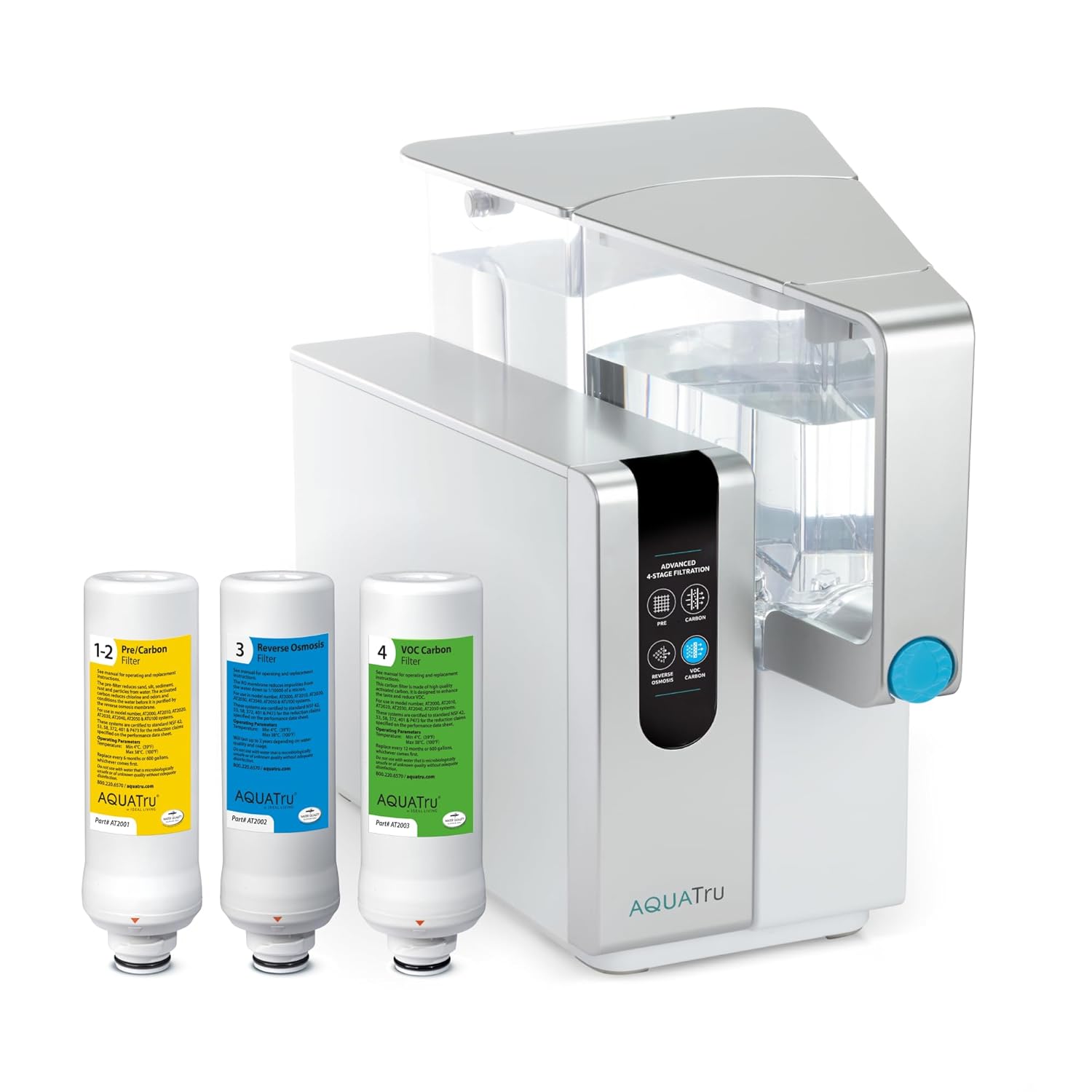
AquaTru Classic — 4-Stage Countertop RO
NSF/ANSI 42 · 53 · 58 · 401 · 4:1 waste ratio · No installation
The most independently verified countertop RO available. AquaTru's 4 NSF certifications cover 83 contaminants including fluoride, lead, PFAS, arsenic, and nitrate. Independently tested to eliminate 100% of fluoride. No plumbing — fills from the top, plugs into a standard outlet.
Check Price on Amazon →🏆 Best countertop with UV — SimPure Y7P-BW
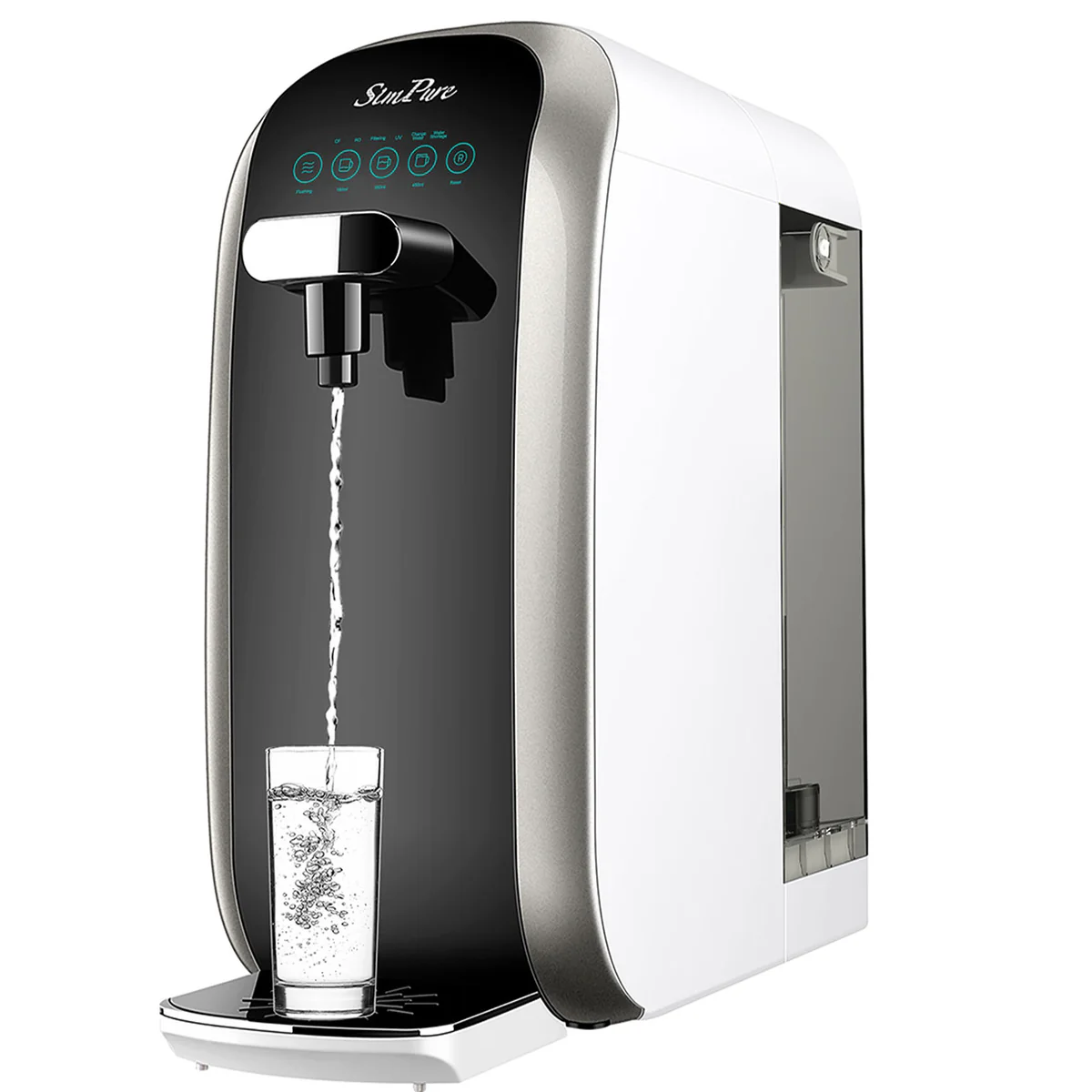
SimPure Y7P-BW — 5-Stage Countertop RO + UV
NSF/ANSI 58 · 100 GPD · UV sterilization · 4:1 waste ratio
NSF 58 certified, removes fluoride, PFAS, lead, and arsenic. At $369 it undercuts AquaTru while adding UV sterilization — bacteria and virus protection AquaTru doesn't have. Auto-dispenses at preset volumes, lower annual filter cost (~$58/year vs AquaTru's ~$120).
Check Price at SimPure →🏆 Best under-sink (tankless) — Waterdrop G3P800
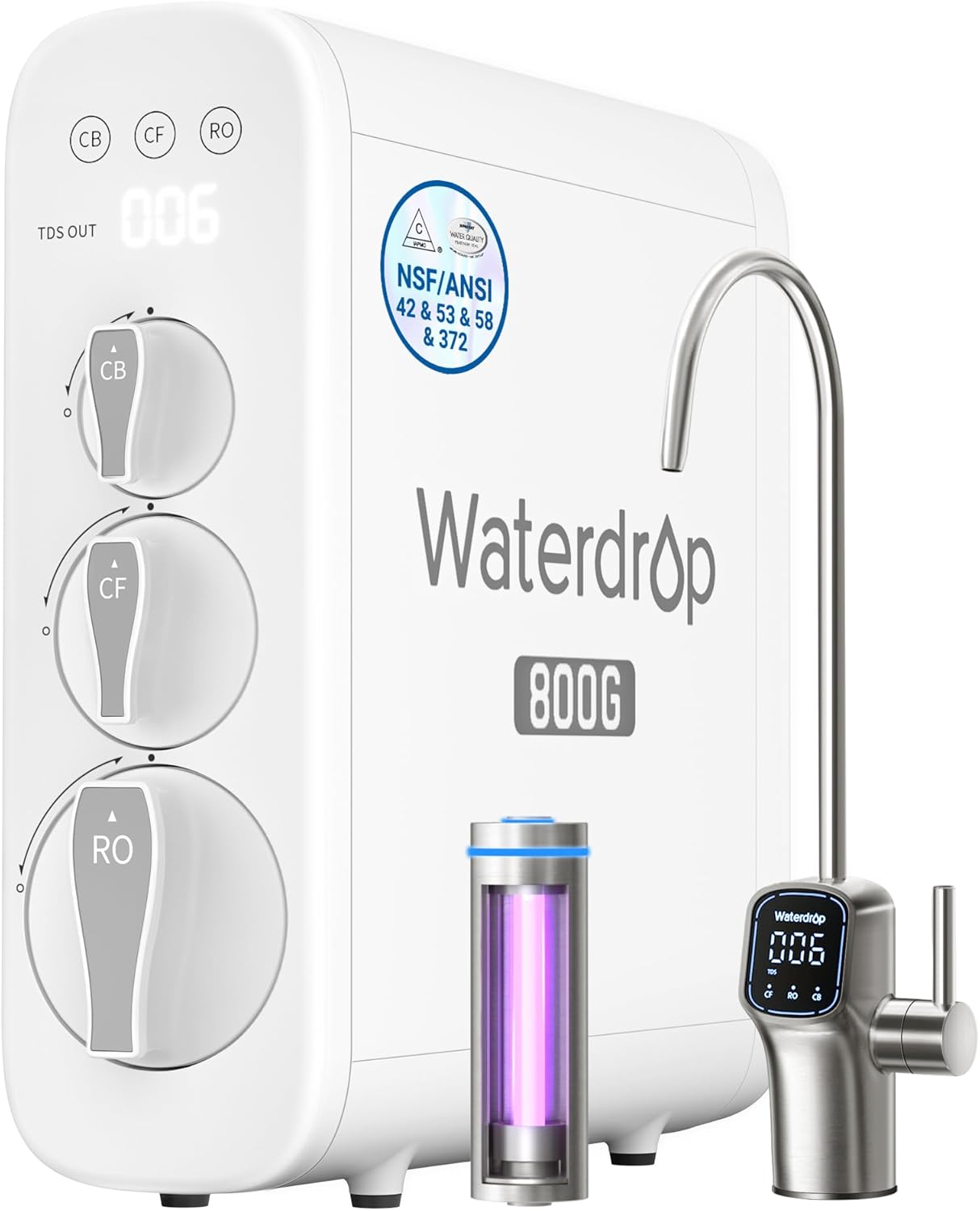
Waterdrop G3P800 — 800 GPD Tankless RO + UV
NSF/ANSI 58 · 372 · 800 GPD · Built-in UV sterilization
The highest-flow tankless under-sink RO currently available. NSF 58 certified for fluoride reduction with built-in UV sterilization. Smart filter indicator, compact no-tank footprint. Best choice for families who want instant high-flow filtered water.
Check Price at Waterdrop →🏆 Best value under-sink — iSpring RCC7AK
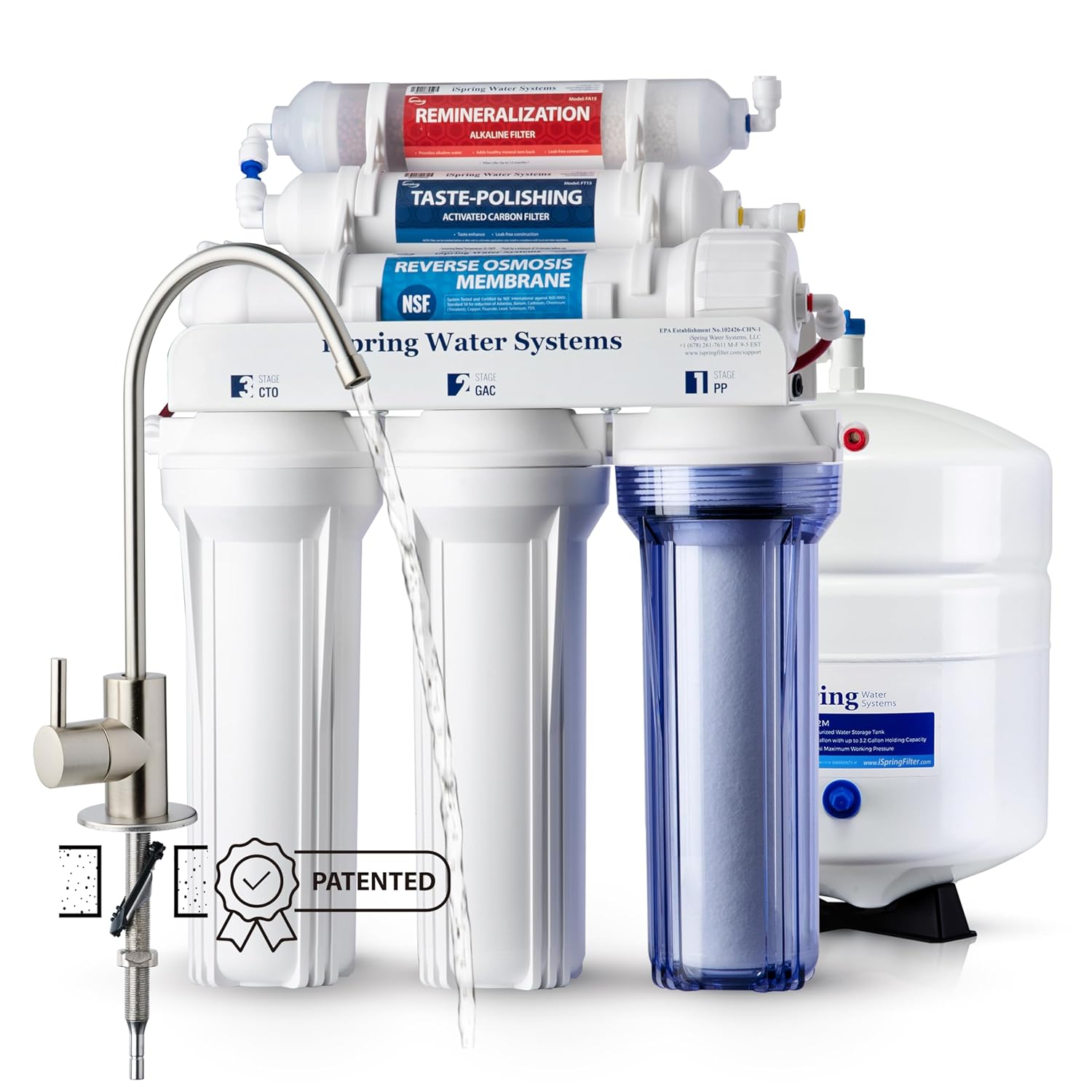
iSpring RCC7AK — 6-Stage Under-Sink RO
WQA Certified · 75 GPD · Alkaline remineralization · ~$240
Most affordable certified under-sink RO that removes fluoride and re-adds alkaline minerals post-filtration. WQA certification confirms fluoride reduction. Standard 10-inch filters keep annual replacement cost under $70. Best for buyers who want proven under-sink RO without tankless pricing.
Check Price at iSpring →Bottom line
Any reverse osmosis system with an NSF/ANSI 58 certified membrane removes 90–96%+ of fluoride as part of normal operation. No special fluoride filter or add-on needed. Check the NSF certification number on any RO you're considering — that single credential guarantees real, independently verified performance.
Frequently Asked Questions
Yes. Reverse osmosis removes 90–96% of fluoride through the semi-permeable RO membrane. The membrane rejects fluoride ions through size exclusion and charge repulsion. NSF/ANSI 58 certified systems have this performance verified by independent lab testing.
Most RO systems remove 90–96% of fluoride. AquaTru is independently tested to eliminate 100% from water with 1.4 PPM incoming concentration. At typical US municipal levels (0.7 PPM), even 90% removal brings output to under 0.1 PPM — undetectable by taste.
Trace amounts may remain. At 95% removal and 0.7 PPM incoming, filtered water contains approximately 0.035 PPM — far below any health guideline and undetectable by taste or smell. For well water with naturally high fluoride above 4 PPM, a premium high-rejection membrane is worth specifying.
Activated carbon filters, Brita pitchers, PUR pitchers, refrigerator filters, faucet-mounted carbon filters, and whole-house carbon systems do not remove fluoride. UV sterilization also has no effect on fluoride. Fluoride is a dissolved ion that passes through carbon unchanged — only RO, activated alumina, bone char, or distillation removes it.
Yes. The carbon pre-filter stage removes chlorine before water reaches the membrane (also protecting the membrane from chlorine degradation). The RO membrane removes fluoride. Both contaminants are handled in the same 4–6 stage system without any additional setup.
No. All standard reverse osmosis systems remove fluoride through normal filtration. There is no special "fluoride RO" — any genuine RO system achieves 90%+ fluoride removal. Look for NSF/ANSI 58 certification to verify the manufacturer's claim is backed by independent testing.
For countertop: AquaTru Classic has the broadest certification set (NSF 42/53/58/401) and is independently tested to eliminate 100% of fluoride. For under-sink: Waterdrop G3P800 (800 GPD, NSF 58) or SimPure Y7P-BW (NSF 58 + UV) are both strong at different price points.
Keep reading
- AquaTru Classic Review — our top countertop RO pick
- SimPure Y7P-BW Review — best budget countertop RO with UV
- Waterdrop G3P800 Review — 800 GPD tankless under-sink
- iSpring RCC7AK Review — best value under-sink RO
- Does Waterdrop remove fluoride? — brand-specific breakdown
- Best countertop RO filters 2026
- Best under-sink RO systems 2026
- RO replacement filter guide — costs by brand