Buy the G3P600. The G2 is a budget fallback — not a real alternative.
The G3’s 3:1 waste ratio vs the G2’s 1:1 means the G3 wastes 66% less water for the same output. The G3 adds NSF 42, 53, and 401 certifications the G2 doesn’t have. The G3 has a smart TDS-display faucet. PFAS reduced to Non-Detect on independent lab testing. If budget is genuinely tight and you understand you’re getting a less efficient, less certified system, the G2 works. Otherwise the G3P600 is the right choice for anyone buying new.
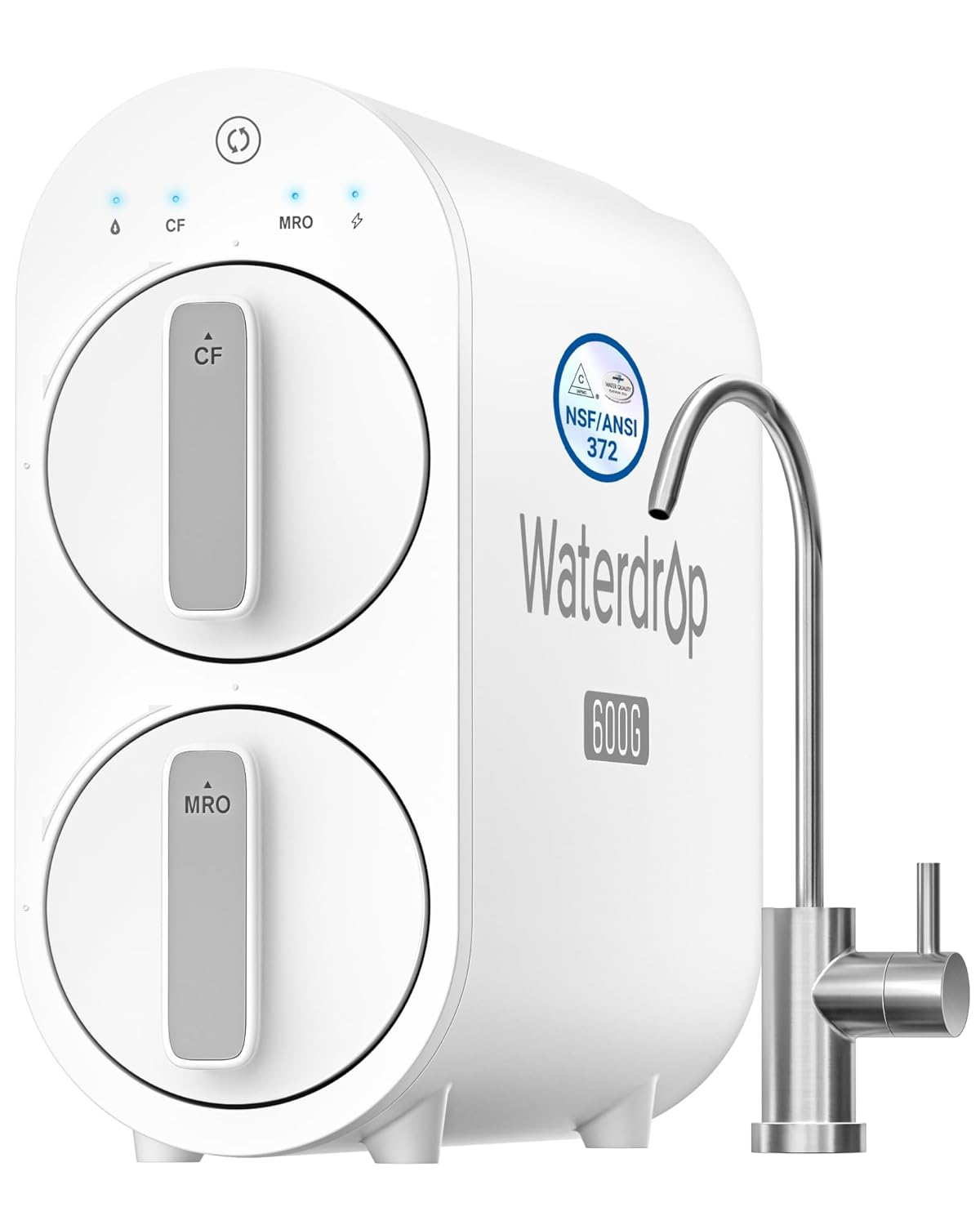
Waterdrop G2 / G2P600
400 GPD • 2-filter • 1:1 ratio • LED indicators
Budget / Legacy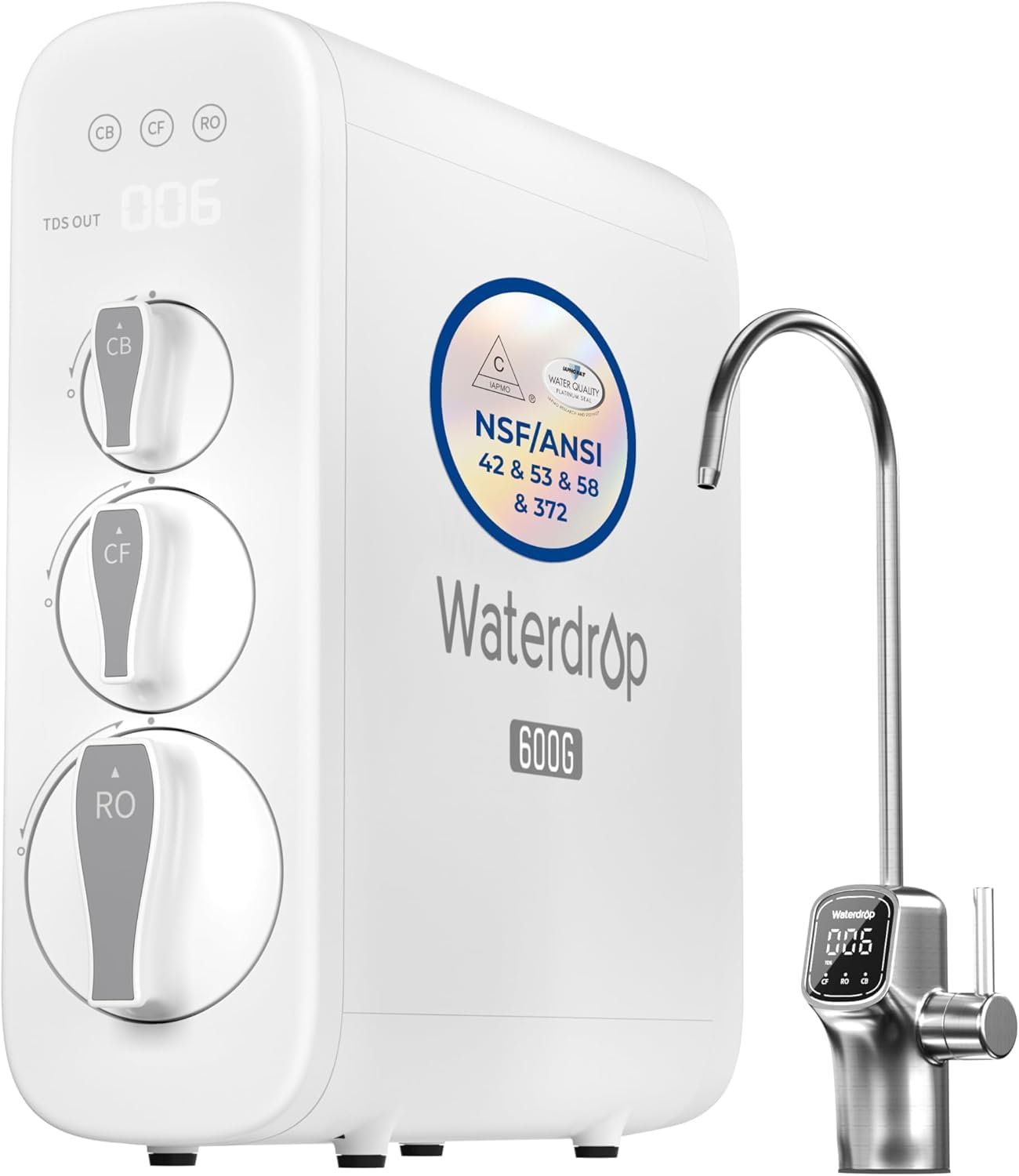
Waterdrop G3P600 / G3P800
600–800 GPD • 3-filter • 3:1 ratio • TDS display
✓ RecommendedFull Comparison — Every Difference
| Feature | G2 / G2P600 | G3P600 / G3P800 | Winner |
|---|---|---|---|
| Pure-to-drain ratio | 1:1 — 1 wasted per 1 purified | 3:1 — 1 wasted per 3 purified | G3 ✓ |
| Flow rate (base) | 400 GPD | 600 GPD (G3P600) / 800 GPD (G3P800) | G3 ✓ |
| NSF certifications | NSF 58 & 372 | NSF 42, 53, 58, 372, 401 | G3 ✓ |
| Filtration stages | 7 stages | 7–8 stages (G3P600) / 8 stages (G3P800) | G3 ✓ |
| Filter cartridges | 2 (CF + MRO) | 3 (CF + CB + RO) | G3 ✓ |
| Faucet display | LED indicator lights only | Smart display — real-time TDS + filter life | G3 ✓ |
| Auto-flush system | No | Yes — multiple triggers | G3 ✓ |
| PFAS to Non-Detect | Not independently confirmed | Yes — Tap Score 14/14 analytes ND | G3 ✓ |
| System price | Lower | Higher | G2 ✓ |
| Filter cost (annual) | ~$60–$80 | ~$80–$100 | G2 ✓ |
| Filter interchangeable? | NO — G2 and G3 filters are completely different. Not cross-compatible. | ||
The 1:1 vs 3:1 Waste Ratio — What It Means in Practice
This is the most important operational difference between the G2 and G3. The G2’s 1:1 ratio means for every gallon of purified water it produces, it sends one gallon to drain. The G3’s 3:1 ratio means it sends only one gallon to drain for every three gallons produced.
3 gal/day to drain
1,095 gallons wasted per year
1 gal/day to drain
365 gallons wasted per year
Filtration System — G2 vs G3 Filter Architecture
G2 — 2 Cartridges, 7 Stages
PP sediment + activated carbon (pre-filtration)
RO membrane + activated carbon block (combined)
G3 — 3 Cartridges, 7–8 Stages
Sediment + carbon pre-filter (replaced 2× per year)
Coconut shell carbon block
RO membrane + carbon post-filter
NSF Certifications — G2 vs G3
| Standard | Covers | G2 | G3 |
|---|---|---|---|
| NSF 42 | Aesthetic effects — chlorine, taste, odor | ✗ | ✓ |
| NSF 53 | Health effects — lead, cysts, VOCs | ✗ | ✓ |
| NSF 58 | RO system performance and contaminant reduction | ✓ | ✓ |
| NSF 372 | Lead-free materials | ✓ | ✓ |
| NSF 401 | Emerging contaminants including PFAS | ✗ | ✓ |
Smart Faucet — G2 LED vs G3 TDS Display
G2 Faucet
- LED indicators: blue = good, yellow = replace soon (15 days), red = replace now
- No TDS display — separate meter needed to verify rejection
- Cup fill: ~12 seconds for 8 oz
G3 Smart Faucet ✓
- Real-time TDS display — see actual ppm while dispensing
- Individual filter life tracking for CF, CB, and RO
- Error code display (E02, E03, E04)
- Cup fill: 6–7.5 seconds (G3P800)
G3 Auto-Flush System — 4 Triggers
The G3 includes an automated flushing system that the G2 lacks entirely. Four conditions trigger automatic flushing:
| Trigger | When It Runs | Purpose |
|---|---|---|
| 2-hour accumulative | After every 2 hours of cumulative operation | Removes concentrate buildup from membrane surface |
| Post-power-outage | Every time power is restored | Clears stagnant water from extended non-operation |
| 5-minute tap-off | 5 minutes after faucet is closed | Maintains membrane freshness after each use |
| 12-hour idle | After 12 hours without any water dispensing | Prevents stagnation during extended low-use periods |
Filter Part Numbers & Compatibility
| Model | Filter | Part Number | Replace Every |
|---|---|---|---|
| G2 | CF Composite | WD-G2-CF | 12 months |
| MRO Membrane + Carbon | WD-G2-MRO | 24 months | |
| G3P600/P800 | CF Pre-Filter | WD-G3-N1CF | 6 months |
| CB Carbon Block | WD-G3-N3CB | 12 months | |
| RO + Post-Carbon | WD-G3-N2RO | 24 months |
Real-World Performance Data
Real user TDS reductions: Chicago user went from 115–139 ppm tap → 3–4 ppm post-G3. Well water user went from 1,200 ppm → 35–40 ppm. Homebrewing applications: 8–14 ppm post-filtration for blank-slate recipe building.
G3 Error Codes
| Code | Meaning | Resolution |
|---|---|---|
| E02 | No water / low inlet pressure | Check cold water supply valve is fully open; verify inlet pressure; check for kinked inlet tubing |
| E03 | Leak detected | Inspect all push-connect fittings; verify lock clips engaged; dry all connections; restart |
| E04 | Faucet/TDS sensor fault | Check faucet power cord connection at rear of unit; power off and restart; contact Waterdrop if persistent |