The best budget countertop RO with a glass carafe — if WQA certification is enough for you
The Bluevua RO100ROPOT delivers solid countertop RO performance at $150 less than the AquaTru Classic. The glass carafe, built-in TDS display, and remineralization filter are genuine advantages. The honest limitation: it's WQA certified rather than NSF certified, and Bluevua doesn't publish specific contaminant removal percentages. If you need NSF-verified data, AquaTru is the right call. If you're comfortable with WQA and want glass carafe RO at a lower price, Bluevua is a serious option backed by real buyer volume.
- $299 — $150 cheaper than AquaTru Classic
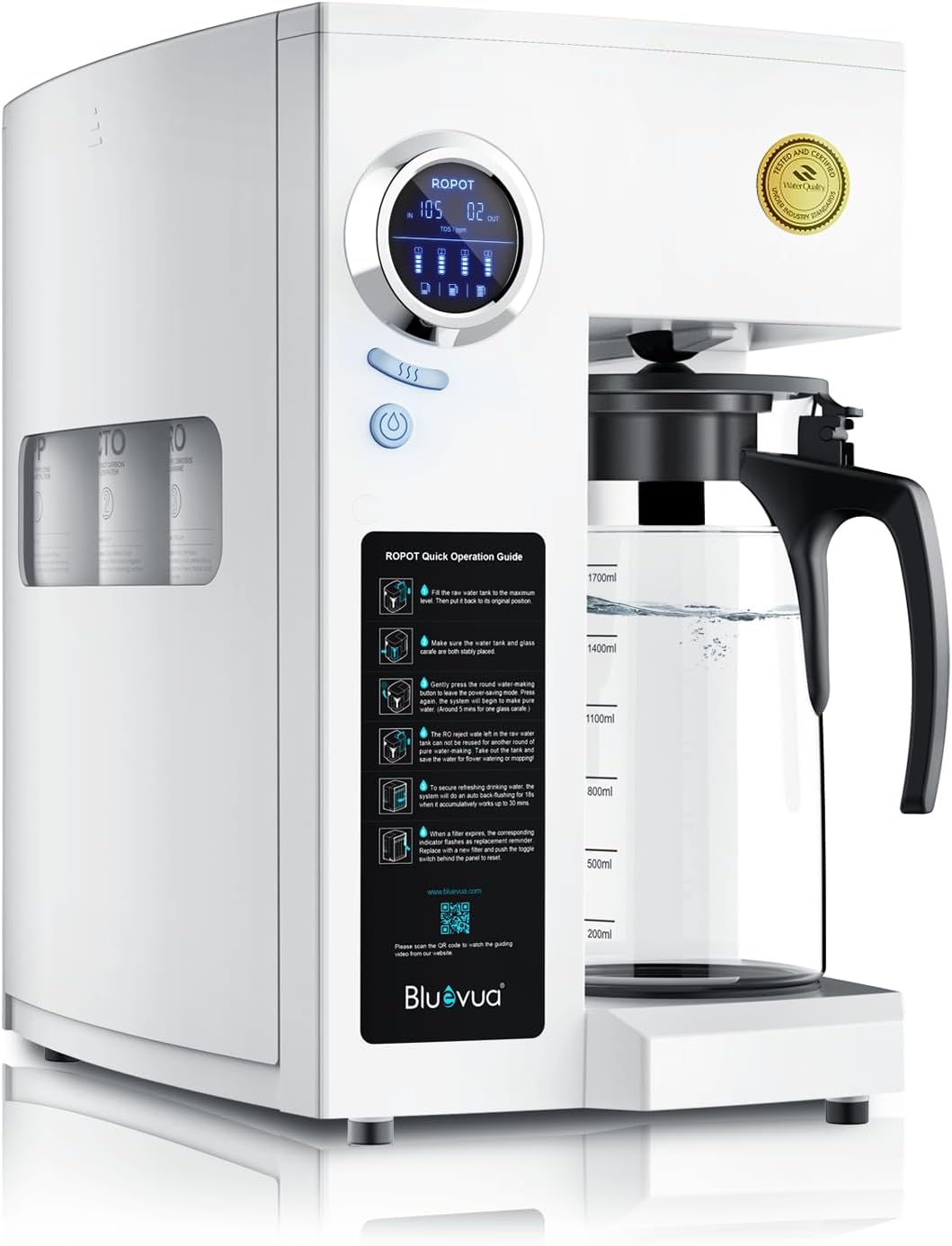
- Glass carafe — 1,700ml capacity
- Built-in TDS display shows before/after readings
- Remineralization included as standard
- 4.6 stars across 3,600+ Amazon reviews
- Amazon's Choice — #2 in countertop filtration
- 500+ units sold per month
- No installation — plug in and go
✓ What we like
- WQA certified — not NSF/ANSI certified
- No published per-contaminant removal percentages
- Slow fill — ~6–7 min per carafe at 0.26 L/min
- Waste ratio not officially published
- Smaller brand — fewer service resources than AquaTru
- Manufacturer is JSK (Chinese OEM)
✗ What to know
Specs at a glance
| Filtration type | 5-stage reverse osmosis (countertop) |
| Certification | WQA certified (not NSF/ANSI) |
| Carafe capacity | 1,700ml (57oz / ~0.45 gallons) — glass |
| Max TDS input | 1,000 PPM |
| Flow rate | 0.26 liters per minute |
| Dimensions | 10.9" L × 15.4" W × 14.3" H |
| Weight | 23.15 lbs |
| Installation | None — countertop, plug-in |
| Power | Corded electric (standard outlet) |
| TDS display | Yes — shows input and output TDS |
| Remineralization | Yes — mineral filter included |
| Amazon rating | 4.6 stars / 3,605 reviews (Amazon's Choice) |
| Current price | $299 (was $434 list price) |
| Warranty | 30-day return / replacement |
How we rate it
The certification question — WQA vs NSF
This is the most important thing to understand about the Bluevua before buying. The RO100ROPOT carries WQA (Water Quality Association) certification — you can see the gold WQA seal on the unit itself. WQA is a legitimate, respected third-party certification body. What it is not is NSF/ANSI certification.
The difference matters in practice:
| NSF/ANSI 58 | Tests and certifies specific contaminant reduction claims for RO systems. Results are publicly verifiable. |
| NSF/ANSI 42 | Certifies aesthetic reduction — chlorine, taste, odor. |
| WQA Gold Seal | Certifies materials are safe for use and system performs as advertised. Less specific on contaminant removal rates. |
In plain terms: NSF certification gives you publicly verifiable data on how much lead, fluoride, arsenic, and other contaminants are actually removed. WQA tells you the system is safe and works — but without the same level of specific, third-party-verified removal data. Bluevua doesn't publish per-contaminant removal percentages, which is one area where AquaTru's full NSF stack is a clear advantage.
For most buyers, WQA is entirely acceptable — the system does use a genuine RO membrane and does remove contaminants. But if you have a specific contaminant concern (arsenic, chromium-6, nitrates) and want verified data, the AquaTru Classic's NSF certifications give you more confidence.
What the Bluevua actually gets right
Price. At $299 on sale from a $434 list price, it's meaningfully cheaper than the AquaTru Classic ($449) and comparable to the AquaTru Carafe ($399). For buyers who want glass carafe countertop RO without the premium brand price, this is the primary reason to consider it.
TDS display. The circular display on the front shows your input TDS (tap water) and output TDS (purified water) in real time. This is genuinely useful — you can see the system working and monitor filter performance over time. When output TDS starts rising, filters need changing. AquaTru doesn't have this feature.
Remineralization included. The RO100ROPOT includes a mineral filter as standard, which adds calcium and magnesium back to the purified water after the RO membrane strips them out. This produces better-tasting water with balanced pH. On AquaTru, remineralization is an add-on.
Real buyer volume. Amazon's Choice status at #2 in countertop filtration, 500+ units sold per month, and 3,600+ reviews at 4.6 stars is not manufactured social proof. Buyers are choosing this and coming back satisfied. That matters more than marketing copy.
The real limitations
Fill speed. At 0.26 L/min, filling the 1,700ml glass carafe takes approximately 6–7 minutes. This is normal for countertop RO but noticeably slower than tankless under-sink systems. If you want instant high-flow water, countertop RO isn't the right category — consider the Waterdrop G3P600 instead.
No published waste ratio. Bluevua doesn't state the waste ratio officially. Based on the flow rate and typical countertop RO performance, expect somewhere in the 3:1 to 4:1 range — higher than modern tankless under-sink systems. This is a transparency issue more than a performance issue, but it's worth noting.
Brand maturity. Bluevua sells through Amazon directly and has a Shopify site (beatylinc.com), but it's a younger brand with fewer support resources than AquaTru or Waterdrop. If you need hands-on customer support or are buying for a use case where reliability is critical, the larger brands have more infrastructure behind them.
Bluevua RO100ROPOT vs AquaTru Classic
This is the comparison most buyers are making. Here's what actually differs:
| Price | Bluevua: $299 · AquaTru: $449 |
| Savings | Bluevua saves $150 upfront |
| Certification | Bluevua: WQA · AquaTru: NSF/ANSI 42, 53, 58, 401, P473 |
| Carafe | Both: glass carafe |
| Carafe size | Bluevua: 1,700ml · AquaTru Carafe: 1,900ml |
| TDS display | Bluevua: yes · AquaTru: no |
| Remineralization | Bluevua: included · AquaTru: add-on purchase |
| Contaminant data | Bluevua: limited · AquaTru: full NSF-verified data |
| Brand support | Bluevua: Amazon only · AquaTru: dedicated customer service |
| Installation | Both: none — countertop plug-in |
The Bluevua wins on price, TDS display, and remineralization included as standard. The AquaTru wins on certifications, contaminant transparency, and brand support. For most buyers the choice comes down to: is $150 worth the NSF certification upgrade?
The Lite(UV) variant — is it worth it?
Bluevua also makes the ROPOT-Lite(UV) (ASIN: B0CZ475FBC) — a UV version at a similar price with 4.4 stars and 3,000+ reviews. Two important differences from the standard RO100ROPOT: the Lite has a maximum TDS input of 300 PPM (vs 1,000 PPM on the standard) and adds UV sterilization.
The 300 PPM TDS limit on the Lite is a significant caveat for many US households. Average US tap water runs 150–400 PPM. If your water is above 300 PPM — which you can check with a $10 TDS meter — the Lite may struggle or produce inadequate filtration. The standard RO100ROPOT's 1,000 PPM limit is far more practical for the typical US water supply.
Unless you have confirmed low-TDS source water and specifically want UV sterilization, the standard RO100ROPOT is the better choice.
Who should buy the Bluevua RO100ROPOT?
✓ Good fit if you...
- Want countertop RO with a glass carafe under $300
- Appreciate the real-time TDS display
- Want remineralization included without extra cost
- Are comfortable with WQA rather than NSF certification
- Rent and want zero installation
- Live alone or with one other person
- Want a proven product with real buyer volume
✗ Look elsewhere if you...
- Need NSF/ANSI certified contaminant removal data
- Have a specific contaminant concern requiring verified data
- Want instant high-flow water (get an under-sink system)
- Have source water above 1,000 PPM TDS
- Prioritize brand longevity and dedicated support
- Have 3+ people in your household
Final verdict
The Bluevua RO100ROPOT is a genuinely good countertop RO at a price that's hard to ignore. The combination of glass carafe, built-in TDS display, remineralization, and $299 price point explains why it's Amazon's Choice at #2 in the category with over 3,600 reviews. Real buyers are choosing it and are satisfied — that's meaningful data.
The honest limitation is the certification gap. If NSF/ANSI certification is important to you — especially if you have specific contaminant concerns you want verified data on — the AquaTru Classic is worth the extra $150. If WQA certification is acceptable and you want to save money on a well-reviewed countertop RO, the Bluevua is a solid buy.
It's not the right answer for everyone. But for the buyer who wants glass carafe countertop RO without AquaTru's price tag, it's the best option in that space.