Buy TSA if...
Your water has visible sediment, rust after outages, or you're specifically concerned about fluoride
Buy 15UA instead if...
Your only complaint is chlorine taste — one cartridge, ~$18/year, same NSF 42 certification
Don't buy if...
You want TDS reduced, you're on well water, or you want the longest maintenance interval possible
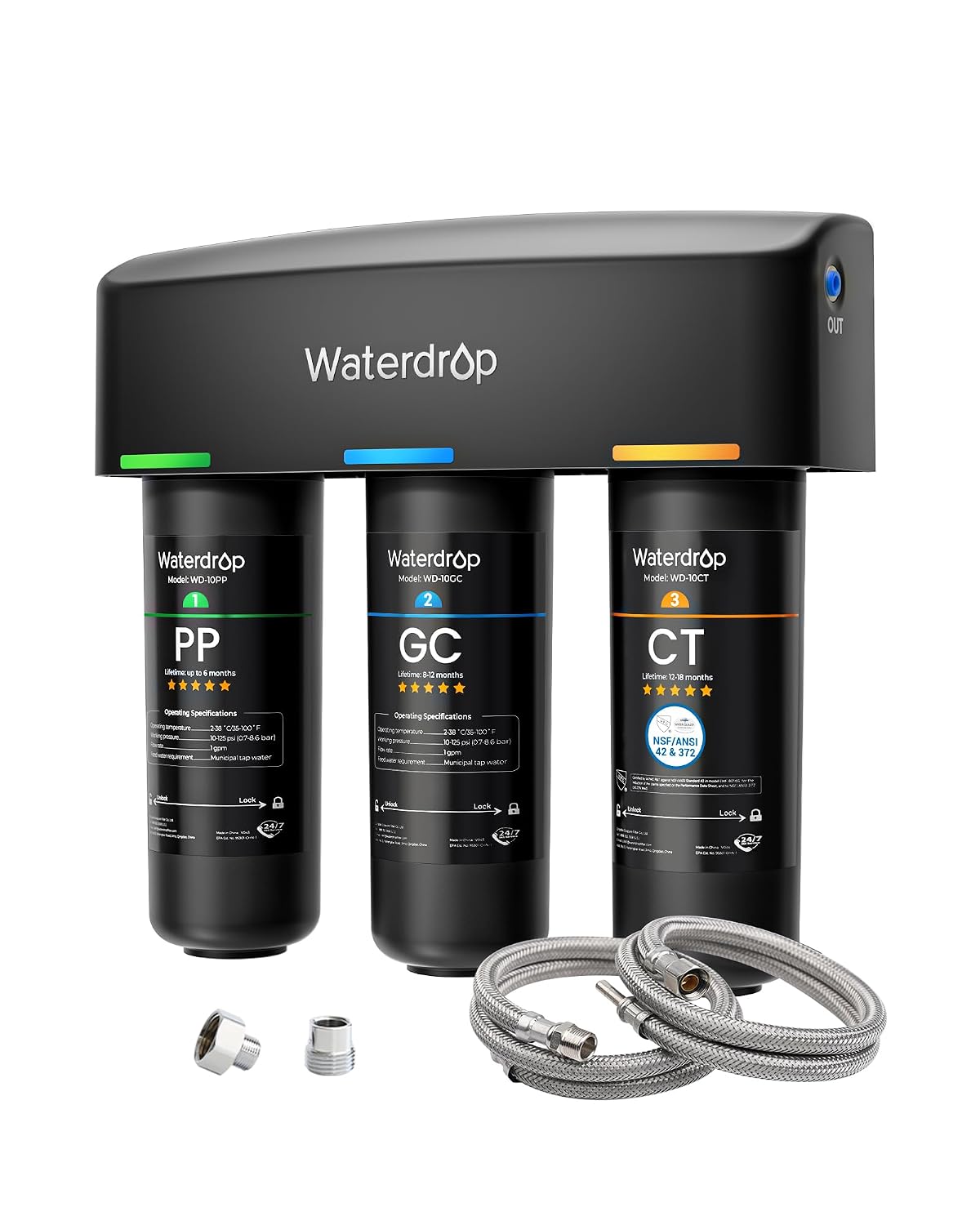
What the TSA actually is
The Waterdrop TSA is a three-stage under-sink filtration system that connects inline to your existing cold-water kitchen faucet — no separate drinking tap, no countertop drilling. All cold water at that sink passes through three cartridges: a PP sediment filter, a granular activated carbon filter, and a certified carbon block with KDF.
It is not a reverse osmosis system and does not reduce TDS. It is designed for municipal cold-water supplies only — not well water, not hot water.
| Key specs | |
|---|---|
| Stages / cartridges | 3 cartridges (marketed as 8-layer) |
| Certification | NSF/ANSI 42 + 372 on stage-3 CT element |
| Reduces TDS? | No — by design |
| Drilling required? | None — direct connect |
| Dimensions | ~16.8 × 12.9 × 4.3 in |
| Thread size | ½ in or ⅜ in female NPT |
| Annual filter cost | ~$107 (2×PP + GC + CT) |
| Amazon ASIN | B08P58F9SG |
The core trade-off: annual filter cost vs. system cost
In this category the hardware is close to a rounding error and the cartridges are the actual purchase. A correct annual filter buy for the TSA — two sediment filters, one granular carbon, one carbon block — runs about $107. Over five years that's roughly $535 in filters alone.
| System | Annual filter cost | 5-year filter total | Notes |
|---|---|---|---|
| Waterdrop TSA | ~$107 | ~$535 | 2×PP + GC + CT; combo pack B-WD-2PPGCCT |
| Waterdrop 15UA | ~$18 | ~$72 | One RF15 cartridge every 2 years, $69.99 system |
| Waterdrop 10UA | ~$30 | ~$150 | One RF10 cartridge annually, $44.99 system |
| CuZn UC-200 | Very low | One cartridge | 50,000-gallon capacity, up to 5 years |
At $107/year, the TSA costs roughly $445 more over five years than the 15UA. That gap is entirely consumables. Name the thing it buys you before you pay it — see the section below.
The two things the TSA does that rivals mostly don't
These are the only two justifications for the higher running cost. If neither describes your water, a cheaper single-cartridge system will taste identical.
1. A dedicated sediment stage
Most direct-connect competitors are single-cartridge composites. The TSA puts a PP cotton filter ahead of the carbon, which makes it viable on supplies with visible grit, rust after outages, or older building mains. On such supplies, a single-cartridge rival will clog long before its rated life. If your sink turns orange after a main break, this matters.
2. Fluoride reduction claim
Waterdrop states the system uses ion exchange resin media that reduces fluoride. Ordinary activated carbon does not meaningfully address fluoride, so this is a genuine point of difference from single-cartridge rivals. Note: this is a manufacturer claim, not part of the NSF/ANSI 42 certification. Ask Waterdrop for the reduction percentage and test data before buying specifically for this reason.
What the NSF certification actually covers
The certified performance and the marketed performance are different lists
The TSA product title on Amazon reads: "Reduces PFAS, PFOA/PFOS, fluoride, chlorine, bad taste and odor — NSF/ANSI 42 certified." NSF/ANSI 42 covers aesthetic effects only — chlorine, taste, and odor. PFAS, fluoride, and health contaminants are not part of that standard. The claims may well be accurate. Only the aesthetic claim has been verified by a third party.
| Standard | What it covers | TSA carries it? |
|---|---|---|
| NSF/ANSI 42 | Aesthetic effects — chlorine, taste, odor, particulates | Yes — CT element, 92.7% chlorine reduction |
| NSF/ANSI 372 | Lead-free material content in the filter parts (≤0.25%) | Yes — note: covers parts, not water |
| NSF/ANSI 53 | Health effects — lead, cysts, VOCs, heavy metals | Not claimed |
| NSF/ANSI 401 | Emerging contaminants, some pharmaceuticals | Not claimed |
Certifying body discrepancy: Waterdrop's own replacement-filter page states the CT element is certified by WQA (model EWF-8016S). The Amazon listing states it has passed IAPMO certification. Both WQA and IAPMO are legitimate accredited bodies. The discrepancy is unresolved — ask Waterdrop for the certificate number if certification is decisive for your purchase.
Direct connect: what it means in practice
The TSA feeds your existing cold-water kitchen faucet — all cold water drawn at that sink passes through all three filters. This is the renter advantage: nothing is drilled. It is also the consumption multiplier: you are filtering dishwater, pot water, and hand-washing water, not just drinking water.
| TSA — direct connect | TSB — dedicated faucet | |
|---|---|---|
| Drilling | None required | 1–1.5 in hole in sink or countertop |
| Renter-friendly | Yes | Usually not |
| Filtered water | All cold water at existing faucet | Dedicated separate tap only |
| Filter consumption | Higher — all cold kitchen use filtered | Lower — only what you draw from the filter tap |
| Flow rate | Reduced on cold side; Waterdrop states this explicitly | Main tap unaffected; filter tap reduced |
| Cartridges | Identical: 10PP, 10GC, 10CT | Identical: 10PP, 10GC, 10CT |
Flow rate is permanent: Waterdrop states filtered water flows more slowly than direct tap. You cannot improve this except by replacing the sediment filter when it loads. Fill a one-gallon jug and time it in the first 30 days — if the flow is frustrating, return it while you still can.
Pros and cons
Pros
- No drilling — installs in minutes on existing faucet
- Dedicated sediment stage — handles grit and rust better than single-cartridge rivals
- Fluoride reduction claim — ordinary carbon doesn't do this
- NSF/ANSI 42 certified element on stage 3
- Wide retail availability — Home Depot, Lowe's, Best Buy, Amazon, Walmart
- 24/7 support; free adapter fittings on request
- 2026 PP filter upgrade improves flow and clogging resistance
Cons
- ~$107/year in filters — more than some rival systems cost outright
- WD-10PP needs replacing every 6 months — highest maintenance in category
- Does not reduce TDS — TDS meter will show no change
- Not suitable for well water or hot water
- Filtered flow noticeably slower than unfiltered tap
- No electronic filter-life indicator — you track replacements manually
- Coconut allergy disclosure buried in listing copy
- Certifying body (WQA vs IAPMO) inconsistent across listings
Four alternatives worth comparing
Waterdrop 15UA — best for chlorine taste only
NSF/ANSI 42 certified, 16,000-gallon single cartridge, direct-connect, no drilling. ~$18/year in filters vs $107. If your complaint is chlorine taste and your water doesn't run rusty, this is the correct buy.
Frizzlife SP99 — best certification
IAPMO-certified to NSF/ANSI 42 and 53. NSF 53 covers health-related contaminants (lead, cysts, VOCs) — which the TSA's NSF 42 does not. If PFAS or lead is the actual concern, this is the stronger basis for that decision.
Waterdrop 17UB — best upgrade within the brand
Also three-stage and direct-connect, but independent reviewers cite a three-year cartridge life — dramatically lower running cost than the TSA's six-month first stage. Named best for PFAS and lead by 2026 reviewers. Worth comparing directly before choosing the TSA.
CuZn UC-200 — best for forgetting about it
50,000-gallon capacity, rated up to five years on one cartridge. The opposite philosophy to the TSA. If you want the longest possible service interval, this is the right architecture.
Common mistakes to avoid
Not costing the filters before buying the system
The system hardware is cheap. The $107/year filter bill is the actual commitment. Price the 1-Year Combo Pack (B-WD-2PPGCCT) before you buy the machine.
Buying the standard 3-filter set annually
One of each filter per year leaves you one WD-10PP short. The PP needs replacing every 6 months. See the full filter replacement guide for the correct annual buy.
Testing with a TDS meter and assuming a fault
TDS will not drop. Waterdrop states this explicitly — the system does not reduce dissolved solids by design. A TDS reading is not a measure of this system's performance.
Missing the coconut allergy disclosure
Waterdrop states the carbon block is made from natural coconut shells and asks buyers to confirm they are not allergic. This appears only in listing copy — not on packaging. Check before ordering if anyone in the household has a coconut or tree-nut sensitivity.
Ordering the wrong replacement cartridges
WD-TSPP and WD-RF10 look similar in search results and do not fit. Read the part number off the installed filter before every order: WD-10PP, WD-10GC, or WD-10CT.
Common questions
Is the Waterdrop TSA NSF certified?
Partially. The stage-3 CT element is certified against NSF/ANSI 42 (aesthetic effects — chlorine, taste, odor) and NSF/ANSI 372 (lead-free materials). NSF 53, which covers health-related contaminants like lead and cysts, is not claimed. There is also a discrepancy between listings — Waterdrop's site says WQA certified, Amazon says IAPMO. Ask Waterdrop for the certificate number if this is decisive.
Does the Waterdrop TSA remove fluoride?
Waterdrop claims it does via ion exchange resin — and ordinary carbon doesn't address fluoride, so this is a genuine differentiator. However it's a manufacturer claim, not part of the NSF 42 certification. Get the reduction percentage in writing before buying for this reason.
Does the TSA reduce TDS?
No. Waterdrop states this explicitly. Essential minerals are themselves dissolved solids, so a TDS meter will show no change. If you want TDS reduced you need a reverse osmosis system.
What is the difference between TSA and TSB?
Same three cartridges, same schedule, same running cost. The TSA connects to your existing faucet — no drilling. The TSB adds a dedicated lead-free stainless faucet and requires drilling a countertop hole. TSB is listed at $149.99 with $50 off advertised.
Can I use the TSA on well water?
No. Waterdrop explicitly states the system cannot filter well water and is for municipal cold-water supplies only. Their WD-PFK pre-filtration kit is recommended as a first step for well supplies.
Buy the Waterdrop WD-TSA
System ASIN B08P58F9SG · Home Depot model B-WD-TSA-10