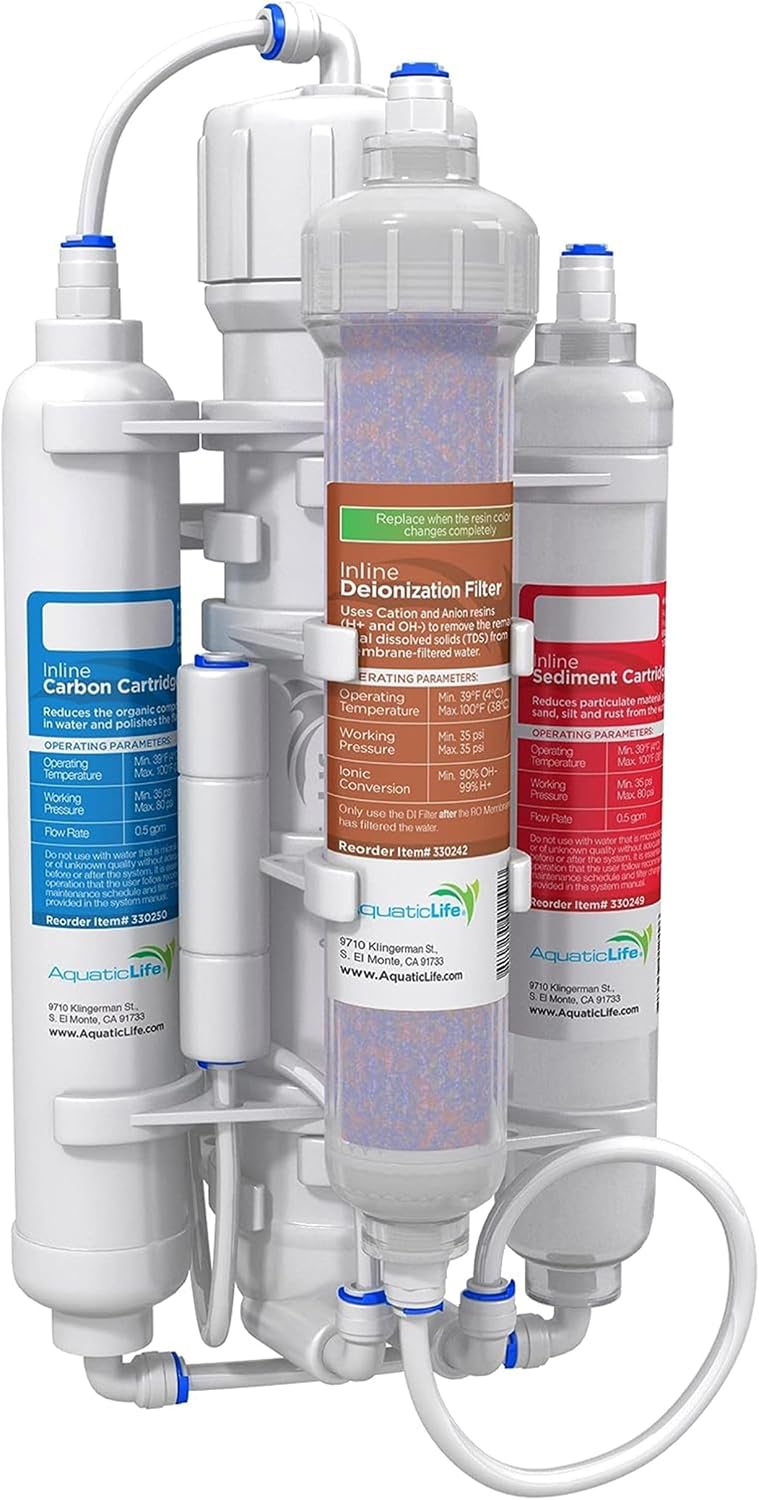
Aquarium and reef tank use — not drinking water
The RO Buddie 540019 is a dedicated aquarium RO/DI system producing 0 TDS / ~0.1 µS/cm — essential for reef tanks, sensitive corals, and discus fish. The DI output is not safe for human consumption.
Other valid uses: humidifiers, decorative fountains, aquaponics, window cleaning, automotive battery top-off.
Check Price on Amazon →⚠️ Critical Warning 1 — Check for chloramines before installing
Contact your local water utility and ask: "Do you use chloramines as a disinfectant?" Many US municipal systems have switched. If YES, purchase and install Chloramine Filter Mfg #540695 (Amazon B09HVDK9FV) upstream of the sediment stage before first use.
Standard carbon cartridges do not adequately remove chloramines. Chloramines rapidly degrade TFC RO membranes — a membrane that should last 12–24 months can fail in weeks.
⛔ Critical Warning 2 — Do not drink DI water
Water filtered through a DI resin cartridge is NOT safe for human consumption. This system is designed exclusively for aquarium and non-drinking applications.
Complete specifications
All specifications sourced from Aquatic Life RO Buddie Official Manual Rev. 02/2022 and aquaticlife.com product page.
| System Specifications — Model 540019 | |
|---|---|
| System type | 4-Stage Reverse Osmosis + Deionization (RO/DI) |
| Membrane output | 50 GPD at 65 PSI / 77°F (~2 gallons per hour) |
| TDS output | 0 TDS / ~0.1 µS/cm after DI stage; 96–98% rejection at membrane |
| Rejection ratio | 1:3.4 to 1:3.5 — approximately 3.4–3.5 gallons waste per 1 gallon filtered |
| Flow restrictor | 450cc (matched to 50 GPD membrane — do not replace unless upgrading to 100 GPD) |
| Pressure range | Optimal 60–65 PSI | Minimum 40 PSI (booster pump required below) | Maximum 80 PSI (regulator required above) |
| Temperature range | 39°F min / 100°F max — never use heated water intentionally |
| Max incoming TDS | 1,800 ppm (warranty condition) |
| Max hardness | 10 grains per gallon / 170 ppm (warranty condition) |
| Max iron | Less than 0.2 ppm (warranty condition) |
| Mount orientation | Vertical ONLY — horizontal operation produces higher output TDS |
| DI resin type | MBD-30-NG Nuclear Grade color-changing mixed-bed resin |
| Dimensions / weight | 7.2 × 4 × 13.8 inches / 4.5 lbs shipped |
| Warranty | 1-year limited on unit; cartridges and membrane excluded |
| Support | customersupport@aquaticlife.com | 888-548-3480 |
How the 4 filtration stages work
| Stage | Filter | Part # | What it removes | Change frequency |
|---|---|---|---|---|
| Stage 1 | Sediment (5 micron) | #330249 | Dirt, silt, rust, sand >5 microns | Every 3–6 months or 1,500 total gallons |
| Stage 2 | Carbon Block | #330250 | Chlorine, VOCs, taste and odor | At 1 ppm Cl: ~1,500 total gal / ~400 filtered gal. Halve at 2 ppm, halve again at 3 ppm |
| Stage 3 | 50 GPD TFC RO Membrane | #330084 | 96–98% of TDS: arsenic, lead, nitrates, heavy metals, dissolved minerals | Every 12–24 months with proper pre-filter maintenance |
| Stage 4 | Color-Changing DI Resin | #330242 | Remaining TDS after membrane — produces 0 TDS via ion exchange | Replace by color: blue/green (fresh) → tan/amber (exhausted) |
The carbon cartridge protects the membrane — change it on schedule
Per the manual: "Any chlorine not absorbed by a spent carbon cartridge will break down your membrane, thus greatly shortening its life." Carbon costs a fraction of a replacement membrane. Change it before exhaustion — don't wait for visible signs.
Installation sequence — the two steps that matter most
Flush the carbon cartridge for 5 minutes — before installing the membrane
Run water with both waste and filtered lines to drain until water runs clear. Removes carbon fines. Do not install the membrane until this flush is complete.
Flush the RO membrane for 30 full minutes — before connecting the DI cartridge
The membrane ships with preservative. If preservative reaches the DI resin it contaminates and ruins the cartridge. Discard all water from this 30-minute flush. Only then connect the DI cartridge.
Press fitting technique: the "double push" is required
Push tubing in — feel the first stop — push again until the 5/8" mark is flush with the fitting face. The first stop is NOT watertight. Only the second push past the O-ring seals the connection. Cut all tubing square with the included razor blade — angled cuts will not seal.
Pressure and temperature correction tables
| Pressure | Actual output |
|---|---|
| <40 PSI | Booster pump required |
| 40 PSI | ~33.5 GPD |
| 50 PSI | ~41.5 GPD |
| 65 PSI ✓ | 50 GPD (rated) |
| >80 PSI | Regulator required |
| Temperature | Actual output |
|---|---|
| 50°F / 10°C | ~29 GPD |
| 60°F / 16°C | ~36.5 GPD |
| 77°F / 25°C ✓ | 50 GPD (rated) |
| 90°F / 32°C | ~61.5 GPD |
| >100°F | Never — membrane damage |
Replacement parts and value packs
| Item | Mfg # | Amazon ASIN | Notes |
|---|---|---|---|
| Sediment Cartridge | 330249 | B00DOG6614 | Stage 1; 3–6 months |
| Carbon Block Cartridge | 330250 | B00DOG66RI | Stage 2; most critical — failure destroys membrane |
| 50 GPD TFC RO Membrane | 330084 | B00DOG656K | Stage 3; 12–24 months |
| 100 GPD TFC RO Membrane | 330093 | B001XYD2IO | Upgrade; requires 800cc restrictor; DI not compatible |
| DI Resin Cartridge | 330242 | See Amazon | Stage 4; replace by color change (blue → amber); Nuclear Grade resin |
| Chloramine Filter | 540695 | B09HVDK9FV | Required if municipal water uses chloramines; install before Stage 1 |
| Value Pack: Sed + Carbon + 50 GPD Membrane | 330445 | B01LBK3KWC | Recommended annual maintenance bundle; ~15–25% cheaper than individual |
| Value Pack: Sed + Carbon + DI Resin | 330656 | B08HC2JRZR | Ideal if DI exhausts on similar timeline to carbon/sediment |
| Value Pack: Sed + Carbon + 100 GPD Membrane | 330446 | B01LBK9OR2 | For upgraded 100 GPD configurations |
Troubleshooting quick reference
| Symptom | Likely cause | Solution |
|---|---|---|
| Leaks at press-fit connection | Tubing not double-pushed to 5/8"; angled cut | Depress collar, remove tubing; re-cut square; re-insert using double-push |
| No filtered water production | Water supply off; flow restrictor blocked; clogged cartridges | Open supply valve; check restrictor; test by removing membrane elbow tubing |
| Low production rate | Pressure below 65 PSI; cold water; clogged sediment; aging membrane | Apply correction tables; replace sediment; check TDS rejection |
| High TDS after DI stage | DI resin exhausted (amber color); DI connected before membrane flush | Replace DI resin; if preservative contaminated, flush membrane fully then install new DI |
| High TDS in RO output (pre-DI) | Exhausted carbon; aging membrane; chloramine damage | Replace carbon immediately; assess membrane; if chloramines confirmed add #540695 and replace membrane |
| DI resin exhausts very quickly | Very high incoming TDS; degraded membrane passing high TDS | Test membrane rejection directly; replace membrane if rejection has dropped |
| Chemical taste from output | Preservative not flushed before DI was connected; biofilm from storage | Disconnect DI; flush 30+ min; reconnect with new DI; replace all cartridges if storage issue |
Storage rules
Never freeze the unit
Water inside the membrane housing expands when frozen and permanently tears the TFC membrane. Never store in an unheated space in winter.
More than 2 weeks idle: seal and refrigerate
Disconnect from water, place in airtight bag, store in the refrigerator. Biofilm can grow in stagnant water. Flush 5–10 minutes before next use.
No direct sunlight operation
UV degrades tubing and housings; heat can warm incoming water above membrane limits.
Common questions
What is the difference between the 3-stage and 4-stage RO Buddie?
The 4-stage (Model 540019) adds a DI resin cartridge that polishes RO output to true 0 TDS / ~0.1 µS/cm. For reef tanks, sensitive corals, and discus fish, the 0 TDS output is necessary. For basic freshwater tropical tanks, the 3-stage may be adequate.
Do I need a chloramine filter?
You must check first. Contact your water utility before installing. If they use chloramines, purchase and install Mfg #540695 (Amazon B09HVDK9FV) upstream of the sediment stage. Standard carbon does not adequately remove chloramines, and chloramines rapidly destroy the RO membrane.
When do I replace the DI resin?
Replace by color change — not by schedule. Fresh resin is blue, green, or dark blue (wet). Exhausted resin turns light brownish or tan (amber). Replace when the color has completely changed throughout the housing.
Can I upgrade to 100 GPD?
Yes — install the 100 GPD membrane (#330093) and simultaneously change the flow restrictor to 800cc (#9000704). However, the inline DI cartridge cannot be used at 100 GPD flow rate. A separate external DI unit is required if you need DI polishing at 100 GPD.