What is TDS? — the one-paragraph version
TDS stands for Total Dissolved Solids — everything dissolved in your water that isn't an H₂O molecule. As water moves through the environment it dissolves minerals, salts, and compounds from rock, soil, pipes, and treatment chemicals. The result is a mixture of calcium, magnesium, sodium, chloride, sulfate, trace metals, and other compounds measured in parts per million (ppm). A reading of 412 ppm means 412 of every million parts of that water sample is something dissolved. A TDS meter measures electrical conductivity and converts it to an estimated ppm value in about 3 seconds.
What makes up TDS
According to the WHO's background document on TDS (WHO/SDE/WSH/03.04/16), the principal constituents are inorganic salts — primarily calcium, magnesium, sodium, and potassium alongside carbonate, bicarbonate, chloride, sulfate, and nitrate. The LAPL (Los Angeles Public Library) Neighborhood Science resource describes it as "the amount of organic and inorganic materials, such as metals, minerals, salts, and ions, dissolved in a particular volume of water." Organic matter makes up a small fraction. Geographic variation is enormous: the WHO documents natural TDS ranging from under 30 ppm to 6,000 ppm depending on local geology.
| Component | Examples | Source |
|---|---|---|
| Minerals (cations) | Calcium, magnesium, sodium, potassium | Dissolved from rocks and soil; natural groundwater |
| Minerals (anions) | Carbonate, chloride, sulfate, nitrate | Geology; agricultural runoff; road de-icing salts |
| Trace metals | Iron, manganese, lead, copper, arsenic | Geological deposits; old plumbing; industrial activity |
| Treatment chemicals | Chlorine, chloramine | Municipal water treatment |
| Organic matter | Humic acids, organic compounds | Natural decomposition; agricultural runoff |
What your TDS reading actually means
Two frameworks matter: the WHO's palatability scale based on taster panel research, and the EPA's regulatory classification. They measure different things and are often confused.
| TDS (ppm) | WHO palatability | Typical taste | Classification |
|---|---|---|---|
| Under 50 | — | Flat, empty — low mineral content | Ultra-pure (RO/distilled output) |
| 50–150 | Excellent | Clean, fresh — Crystal Quest "sweet spot" | Optimal for drinking |
| 150–300 | Excellent | Slight mineral character — very pleasant | High-quality municipal/bottled water |
| 300–500 | Good | Mild mineral taste; US tap average ~350 ppm | Acceptable — approaches EPA guideline |
| 500–900 | Fair | Noticeable mineral or salty taste; scale begins | Above EPA guideline — investigate further |
| 900–1,200 | Poor | Heavy, salty or bitter; most find unpleasant | Elevated — treatment recommended |
| Above 1,200 | Unacceptable | Strongly salty or bitter | High — comprehensive lab test required |
500 ppm is an aesthetic guideline — not a health safety cutoff
The EPA classifies TDS as a Secondary Maximum Contaminant Level (SMCL) — a guideline based on aesthetic concerns (taste, odor, scale), not a legally enforceable health limit. The EPA's primary MCLs — enforceable limits for lead, arsenic, nitrates, and bacteria — are entirely separate from TDS. Water can be above 500 ppm TDS and still meet all primary health standards. Conversely, water below 500 ppm can still contain dangerous levels of PFAS or lead.
What a TDS meter cannot tell you
⚠️ A TDS meter is not a safety detector
TDS meters measure electrical conductivity. They cannot identify what's dissolved or whether it's dangerous. PFAS ("forever chemicals"), pesticides, pharmaceuticals, and most organic contaminants have no ionic charge — they're completely invisible to a TDS meter.
Toxic metals like lead and arsenic are dangerous at parts-per-billion concentrations — 1,000× lower than what TDS meters display in parts-per-million. Even dangerous lead levels may not meaningfully move a TDS reading. For health-based water safety assessment, a comprehensive laboratory water test is required.
| Question | TDS can tell you | TDS cannot tell you |
|---|---|---|
| Is my RO filter working? | Yes — compare before/after; RO should reduce by 90–98% | Which specific contaminants are being removed |
| Is my water safe to drink? | High TDS warrants further investigation | Whether hazardous contaminants are present |
| Are there lead or arsenic levels? | Elevated TDS is a reason to test specifically | Cannot detect at ppb concentrations where danger begins |
| Are there PFAS or pesticides? | Cannot detect at all | Uncharged organic compounds are invisible to TDS meters |
| Is my water hard? | High TDS often correlates with hardness | Cannot give specific hardness value — need a hardness test |
What high TDS does to your home
The WHO states plainly: "High TDS levels (above 500 mg/L) result in excessive scaling in water pipes, water heaters, boilers, and household appliances such as kettles and steam irons. Such scaling can shorten the service life of these appliances."
Water heaters (tank and tankless)
Calcium and magnesium precipitate onto heating elements. Scale acts as thermal insulation — the heater works harder. In tankless water heaters, scale in narrow heat exchanger passages is a documented failure mode. Navien (a leading tankless manufacturer) explicitly documents that scale "hurts efficiency and can trigger error codes." Combi-boilers are particularly sensitive — mineral buildup can cause foaming and corrosion of internal components.
Coffee, cooking, and ice
High-TDS water produces flat coffee — minerals interfere with extraction compounds. Specialty coffee recommends 50–150 ppm. Cloudy ice cubes that melt quickly are a classic symptom: minerals become trapped as water freezes. Foods cooked in high-TDS water can taste differently due to mineral transfer.
Plumbing, fixtures, and appliances
Scale gradually narrows pipe diameter, especially in hot water lines. Dishwashers accumulate scale on heating elements and spray arms, leaving white film on glassware. Faucet aerators clog with deposits. The higher the TDS from calcium and magnesium, the faster these effects compound. Navien: "faucets, fridge dispensers, and other fixtures may wear out faster with gradual mineral buildup."
TDS and your RO filter — monitoring membrane health
This is the most practical use case for most homeowners. Reverse osmosis removes 90–98% of TDS. Monitoring rejection rate over time is the simplest way to track membrane health before performance drops noticeably.
Rejection rate = ((feed TDS − permeate TDS) / feed TDS) × 100
Example: Feed water 412 ppm, post-RO output 9 ppm. Rejection rate = ((412 − 9) / 412) × 100 = 97.8% — excellent membrane performance. A new RO membrane achieves 95–98% rejection. When rejection drops below 85%, the membrane needs replacement regardless of gallon count.
| Post-RO TDS (from 400 ppm feed) | Rejection rate | Membrane status |
|---|---|---|
| Under 20 ppm | 95%+ | Excellent — membrane performing well |
| 20–40 ppm | 90–95% | Good — normal operation |
| 40–80 ppm | 80–90% | Declining — increase monitoring frequency |
| Above 80 ppm | Under 80% | Replace membrane — performance failing |
Is very low TDS water from an RO filter safe to drink?
Yes. The LAPL Neighborhood Science resource states directly: "No, low TDS water is not harmful. A low TDS level actually means you have high-quality water, but it may have a flat taste, as it is devoid of many minerals." The WHO agrees. Your body gets its mineral needs overwhelmingly from food — water's contribution is secondary for most nutrients.
If very low TDS water tastes flat, an RO system with a remineralization stage adds back beneficial minerals and brings TDS to 30–100 ppm — widely considered the sweet spot for drinking water that balances purity with pleasant mineral character.
Best TDS meters for home water testing (2026)
Six picks with distinct use cases. All Amazon affiliate links use the rofilterlab-20 tag.
| Best for | Product | Reviews | Price |
|---|---|---|---|
| Best overall / RO monitoring | HM Digital TDS-3 | 17,000+ (4.5★) | ~$15 |
| Best budget / first meter | HoneForest TDS Meter | 5,000+ (4.4★) | ~$12 |
| Most user-friendly | Varify 4-in-1 | 800+ (4.5★) | ~$18 |
| Before/after RO testing | Varify 2-Pack | 400+ (4.5★) | ~$25 |
| Aquarium / hydroponics | VIVOSUN pH+TDS Kit | 3,000+ (4.3★) | ~$22 |
| Advanced / app + 9 parameters | LKBird 9-in-1 | 200+ (4.4★) | ~$45 |
1. HM Digital TDS-3 — Best Overall

HM Digital TDS-3 Handheld TDS Meter
The industry standard for home RO monitoring — over 17,000 Amazon reviews across more than a decade. 1 ppm resolution, 0–9990 ppm range, rugged housing, carrying case included. Temperature-compensated readings and single-button operation with a hold function. This is the meter water treatment professionals and serious hobbyists actually use. The review count alone says everything about how it performs in real-world conditions.
2. HoneForest TDS Meter — Best Budget

HoneForest TDS, EC & Temperature Meter
Over 5,000 reviews at 4.4 stars — the strongest review base of any budget TDS meter. Reads TDS, EC, and temperature on a backlit LCD. At around $12, this is the right first TDS meter if you've never owned one and want to see what your tap water reads before deciding on an RO system. Compare tap to filtered output in 5 seconds. No learning curve.
3. Varify 4-in-1 — Most User-Friendly
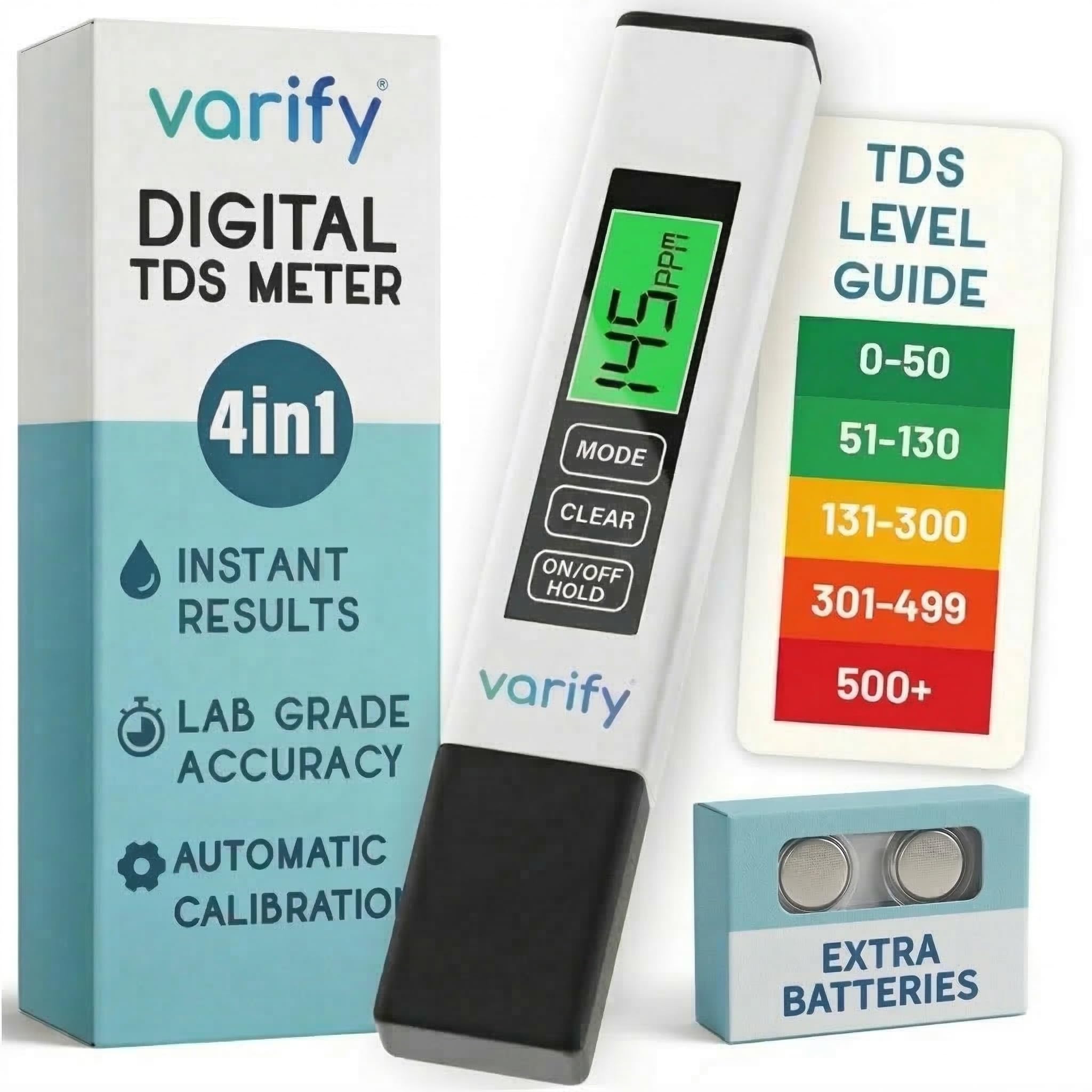
Varify 4-in-1 Instant TDS Meter
Batteries included — works straight out of the box. Reads TDS, EC, and temperature across 0–9990 ppm. The clear display and intuitive mode switching make this the easiest-to-use of these picks, which matters when you're doing a quick check at the sink. Take 2–3 readings and average for highest accuracy — small variation between dips is normal for all pen-style meters.
4. Varify 2-Pack — Best for RO Before/After Testing
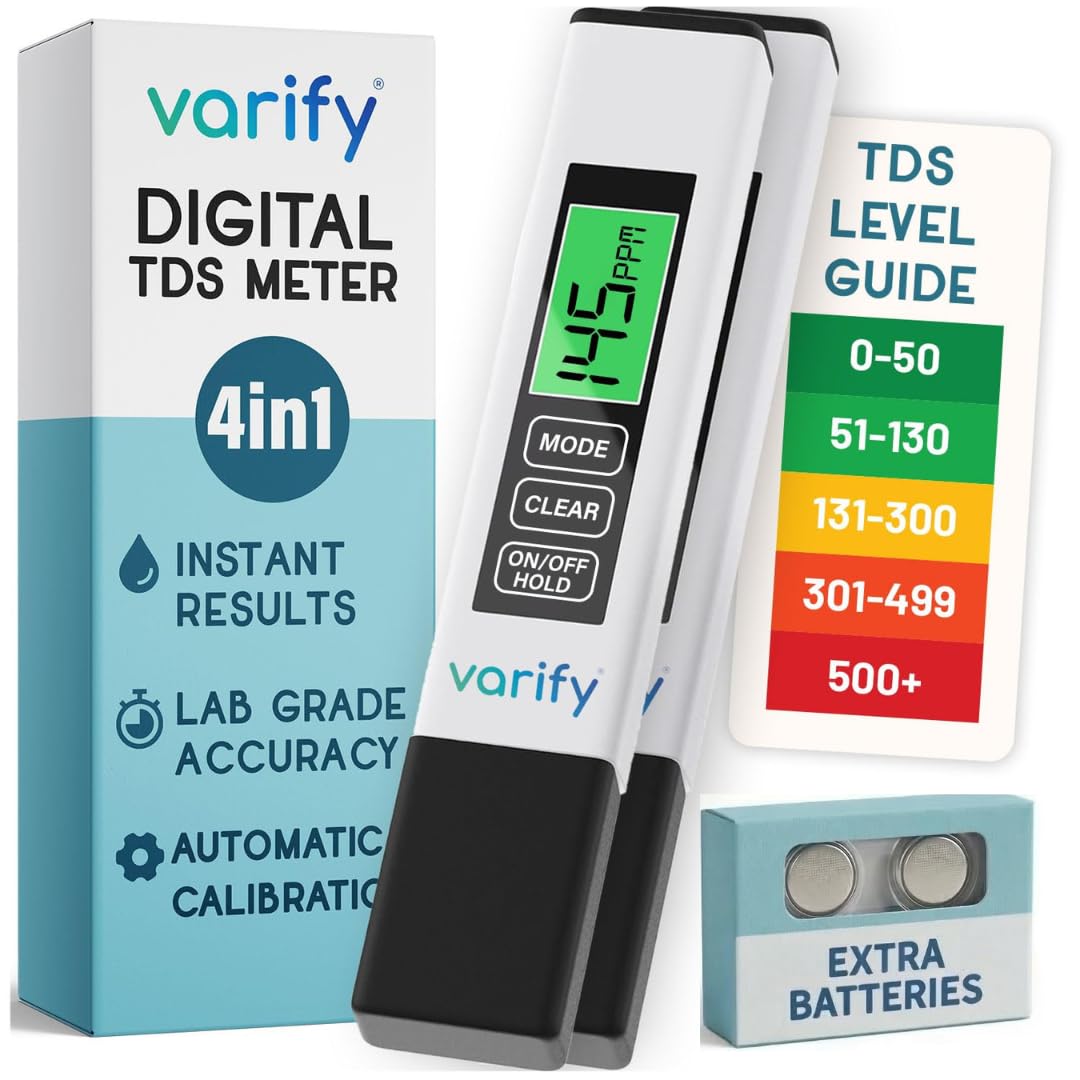
Varify 4-in-1 TDS Meter (2-Pack)
Two meters is the right setup for tracking RO performance. Keep one dedicated to feed water (before the RO) and one to output (after), so you can calculate rejection rate without switching a single meter between two sample points. Also ideal for households with an RO in the kitchen and a separate filter elsewhere. Both units read TDS, EC, and temperature with batteries included.
5. VIVOSUN pH + TDS Kit — Best for Aquariums and Hydroponics

VIVOSUN Digital pH and TDS Meter Kit
Two-piece kit: pH pen plus TDS/EC/temperature meter. The right combination for aquarium owners and hydroponic growers who need to track both acidity and dissolved solids. For RO users: post-filter water is typically low TDS and slightly acidic — tracking both helps you dial in remineralization correctly. Note: the pH pen requires calibration with buffer solution for accurate readings.
6. LKBird 9-in-1 — Best Advanced
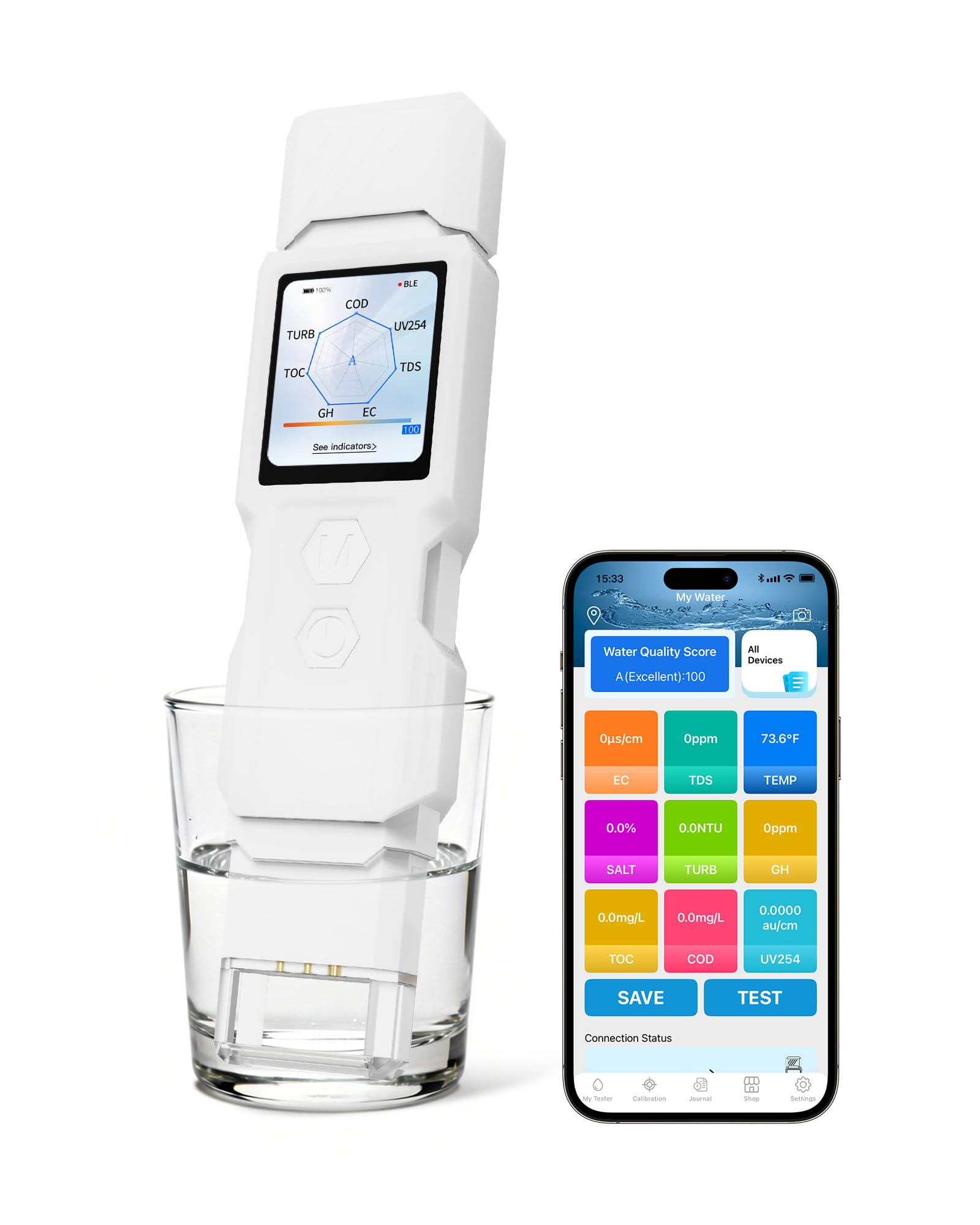
LKBird Smart 9-in-1 Water Quality Tester
Reads TDS, EC, temperature, turbidity, salt, GH, TOC, COD, and UV275 — and logs everything to a companion app for trend tracking. The only pick with app connectivity and turbidity measurement, which is valuable for well water owners monitoring whether sediment filtration is working. At ~$45 it's the highest-priced option, but it genuinely replaces several single-purpose kits. Minor learning curve for the app.
How to use a TDS meter correctly
Let samples reach room temperature
Hot or cold samples shift readings. For consistent before/after RO comparison, test both at the same temperature. Most meters have temperature compensation, but letting samples sit 2–3 minutes improves accuracy.
Dip only to the electrode line
Most pen-style meters have a max depth marking. Submerging the full pen body can damage electronics. Hold in the sample for 5–10 seconds until the reading stabilizes.
Take 2–3 readings and average them
Small variation between dips is normal — averaging gives the most reliable result.
Rinse and dry after every use
Residue from one sample affects the next. Rinse with RO output or distilled water, pat dry, store with the cap on. Remove batteries during extended storage.
Common questions
What should my TDS meter read after an RO filter?
A well-functioning RO system reduces TDS by 90–98%. From 400 ppm feed water, expect 8–40 ppm output. When your post-filter reading rises above 50–80 ppm and feed TDS is unchanged, the membrane is degrading. See the rejection rate table above for the full breakdown.
Does high TDS mean my water is unsafe?
Not necessarily. The WHO states that "reliable data on possible health effects associated with the ingestion of TDS in drinking-water are not available." High TDS is a signal to investigate — harmless calcium and magnesium can produce a high reading while genuinely dangerous PFAS and lead may not register. Use a TDS meter for RO monitoring; use a lab water test for health-based assessment.
Can a TDS meter detect lead, PFAS, or pesticides?
No. PFAS and pesticides are uncharged organic compounds — invisible to TDS meters. Lead and arsenic are dangerous at parts-per-billion, 1,000× lower than what TDS meters display. For health-based water safety, a comprehensive laboratory water test is the right tool.
Is very low TDS water from my RO filter safe to drink?
Yes. Very low TDS water is safe — it may taste flat because it's low in minerals, but your body gets minerals primarily from food. Many RO systems include a remineralization stage that brings TDS to 30–100 ppm for better taste.
How often should I test TDS from my RO system?
Monthly. Test and log both feed TDS and post-filter TDS, then calculate rejection rate. A new membrane achieves 95–98%. When rejection drops below 85% — regardless of gallon count — the membrane needs replacement. Track the trend over time rather than relying on a single reading.
Your TDS is high. Now what?
We've tested 11 RO systems head-to-head. These are the ones that bring TDS from 400+ to single digits.
See our top RO system picks →