The one-sentence version
This is a capable and generously specified RO system for around $478, but you are buying the manufacturer's word rather than a certifier's — and the manual says the system wastes 2.5 gallons per gallon produced while the company's website says the opposite.
Your line pressure is below 45 psi (the pump is the reason this model exists), you want UF + RO in one system, and you're comfortable relying on brand-published rather than certified performance data.
APEC ROES-PH75 or iSpring RCC7AK if certification is important — both carry WQA or NSF certification. Consider the cheaper Thunder 1000C if your pressure is comfortably above 50 psi — the pump premium is roughly $180.
You're a renter, you need third-party verified contaminant removal, you're on well water, or you're not prepared for a professional-level install. The manual recommends a licensed plumber.
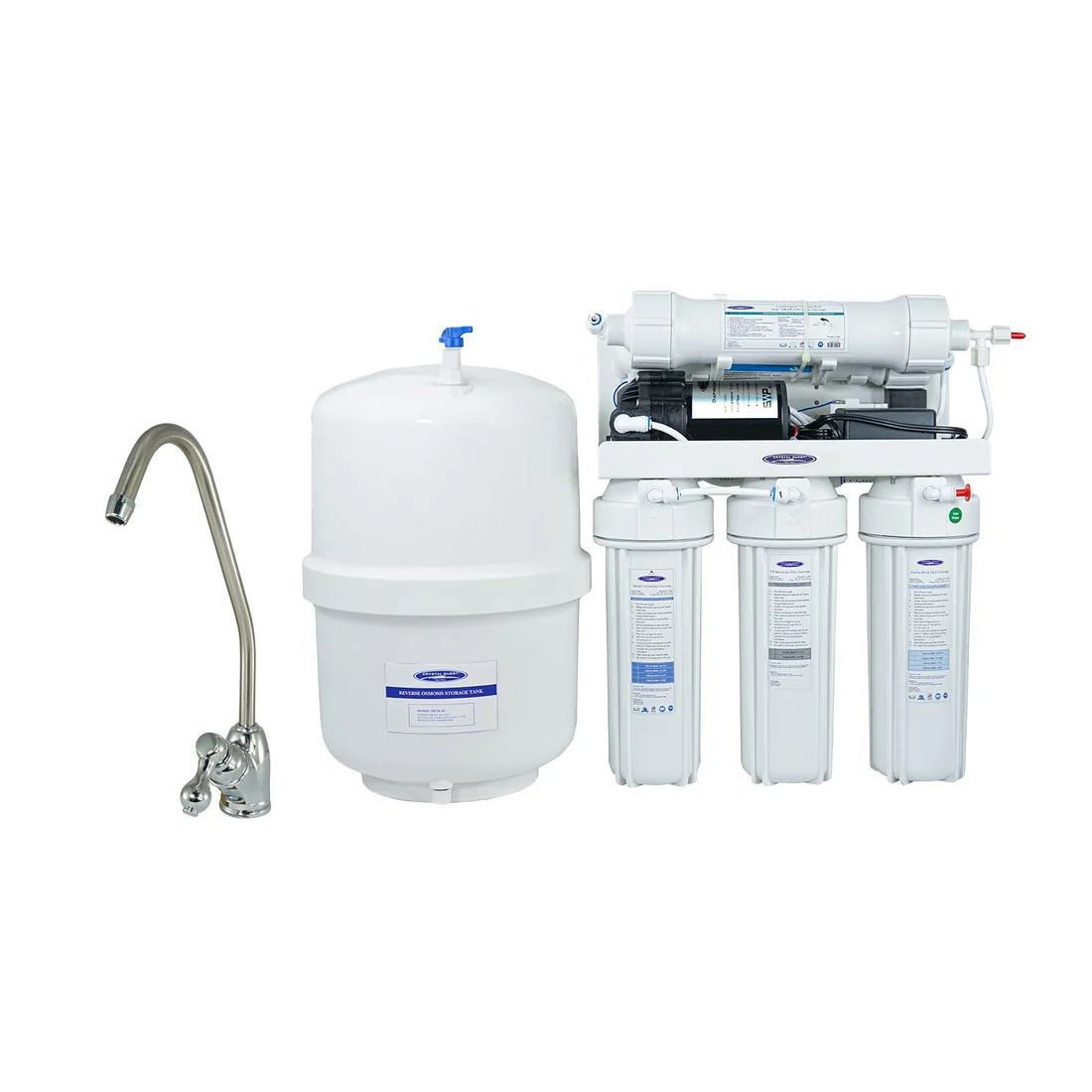
Specifications — from the official installation manual
| Spec | Manual says | Marketing says |
|---|---|---|
| Waste ratio | 2.5 reject : 1 product | 2–4 product : 1 drain (inverted) |
| Rejection rate | >75% stabilized | Up to 99.9% |
| Production | 0.30 GPM at 60 psi | 100 GPD (one reseller: 50 GPD) |
| Pressure range | 30–60 psi | — |
| Temperature | 40–85°F (4.4–29.4°C) | — |
| Tank capacity | 3.2 gal shell / 2.0 gal usable | — |
| Tank fill time | Up to 8 hours or more | — |
| Tank air charge | ~7 psi | — |
| Certification | None stated in manual | None stated |
| Unit lifespan | Replace every 5–7 years | — |
| Warranty | 1 year, Georgia law | — |
The certification finding
No finished Crystal Quest system appears in the NSF, IAPMO, or WQA databases
Independent certification tracking as of May 2026 confirms this. The official installation manual contains no NSF, WQA, or IAPMO mark anywhere in its pages. This is the most important thing to know before buying — not because the system doesn't work, but because you are relying on the manufacturer's word where certified competitors offer a third party's.
| Certification type | What it covers | Thunder 1000CP |
|---|---|---|
| Finished system — NSF/ANSI 58 | The complete RO system as assembled, for contaminant reduction | Not certified |
| Component — Eagle Redox Alloy 6500 | The raw media inside — NSF/ANSI 42 | Component only |
| Component — KDF-55 | The raw media inside — NSF/ANSI 42 and 61 | Component only |
| ISO 9001 | Quality management processes — says nothing about water performance | Yes — process only |
Component certification covers the raw material, not the assembled system. A carbon media certified to NSF 42 in a standalone test is not the same as the assembled system being certified. These are different claims.
For context: NSF published a notice in August 2020 stating Crystal Quest had used the NSF mark on products without authorization prior to June 2020. That issue was subsequently resolved — it is a historical matter, not a current one. But the certification databases remain empty for Crystal Quest finished systems as of 2026.
Three numbers stated two ways — the manual vs. the marketing
These conflicts come entirely from comparing the official installation manual against the company's own website and reseller listings.
1. Waste ratio — the manual is the inverse of the website
Manual says
Minimum 2.5 reject : 1 product
2.5 gal to drain per gal you drink
Website says
2–4 product : 1 drain
As if 2–4 gal produced per gal drained
These are not two estimates of one number — they are opposites. The manual's 2.5:1 reject-to-product figure is exactly what you'd expect from a conventional tank-based RO system and is almost certainly accurate. The website figure appears to be the same ratio written backwards. Plan on 2.5 gallons to drain per gallon produced. On 5 gallons a day of RO water, that's roughly 4,600 gallons a year to the drain.
2. Rejection rate — 75% floor vs. 99.9% ceiling
Manual says
>75% stabilized
After rinse water drains
Marketing says
Up to 99.9%
Retail copy, reseller listings
A healthy RO membrane on municipal water commonly achieves 90% or better. Greater than 75% is a modest floor for the category; 99.9% is an exceptional ceiling. Neither is necessarily wrong — they describe different conditions. Only one ships in the box. The manual gives you the measurement method to check your own installation (see the startup section below).
3. Production capacity — 50 or 100 GPD?
Most listings say
100 GPD
One reseller says
50 GPD
Two figures differ by a factor of two for the same SKU (CQE-RO-00105). The manual gives optimum service flow of 0.30 GPM at 60 psi — which works out to 432 GPD at continuous production, far more than either claimed figure. Confirm the rated GPD in writing for the specific model you order.
What the booster pump actually buys — and when to skip it
The P in 1000CP is the single distinguishing feature between this model and the cheaper 1000C. Crystal Quest's series spans roughly $298 (1000C) to $478 (1000CP) — the pump is carrying about $180 of that difference.
| Your pressure | What happens without a pump | Verdict |
|---|---|---|
| Below 40 psi | RO output collapses — slow fill, poor rejection rate, high waste ratio | Buy the CP — pump is essential |
| 40–50 psi | System works but at the lower end of the manual's 30–60 psi range | CP worth considering |
| 50–60 psi | System performs well without assistance | Save $180 — buy the 1000C |
Measure first. A hose-bib pressure gauge costs about $10 and settles a $180 question in one minute. Attach it to an outdoor tap, run the cold water, read the number. If your pressure is consistently above 50 psi, you don't need the pump.
What 12 stages actually means
12 stages, 5 replaceable cartridges
The 12 stages are media layers distributed across five cartridges — multiple layers within a single housing each count as a separate stage. Stage counts are not comparable across brands. The useful questions are: how many cartridges, how often, at what cost, and what's verified about their performance.
| Part number | Cartridge | Role |
|---|---|---|
| CQE-RC-04001 | 5-micron reusable pleated sediment | Sediment pre-filtration — reusable |
| CQE-RC-04000 | 5-micron carbon block | VOCs, pesticides, chlorine, sediment ≥5 micron |
| CQE-RC-04002 | SMART PLUS cartridge | Multi-media block with Eagle Redox Alloy and KDF |
| CQE-RC-04055 | UF membrane — 0.020 micron | Ultrafiltration — colloids, bacteria, larger organics |
| — | RO membrane | The main event — dissolved solids, TDS reduction |
| CQE-RC-04038 | GAC cartridge | Granular activated carbon post-membrane polish |
| CQE-RC-04040 | SMART cartridge | Final multi-media block |
Optional targeted cartridges: Crystal Quest sells dedicated fluoride (CQE-RC-04006/04049), nitrate (CQE-RC-04007/04050), and arsenic (CQE-RC-04008/04051) cartridges separately. Their existence in the catalogue implies the base system may not fully resolve those contaminants on its own. If a water test found one of these three specifically, ask Crystal Quest which configuration you actually need before ordering the standard 1000CP.
Installation — what the manual actually requires
The manual says to use a licensed plumber. Reseller pages say no plumber needed.
Crystal Quest's manual states all equipment should be plumbed by a qualified, licensed plumber, that the system must meet local, state, and federal plumbing codes, and that Crystal Quest accepts no liability for property damage. Budget professional installation if you're not confident — and note it doesn't extend the 1-year warranty.
The manual's tool list is the clearest signal of installation complexity: safety glasses, variable-speed drill with 1/8" and 1/2" bits, 1-1/4" porcelain hole cutter, 1-1/4" wood bit, chassis punch, plastic tube cutter, low-pressure air gauge, hand air pump, pliers, adjustable wrench, crescent wrench, thread seal tape, household bleach, and a drop light.
| Step | What it involves | Difficulty |
|---|---|---|
| Faucet hole | Use existing sprayer hole or drill 7/8" through stainless, porcelain, or stone | High — porcelain requires water lubrication technique |
| Supply tap | Saddle valve piercing cold line, or T-valve on flex line. Manual warns saddle valves won't self-pierce iron or brass — drill first. | Moderate |
| Drain connection | Drill through drainpipe above trap, never near a disposal. Irreversible. | Moderate, irreversible |
| Mount unit | Cabinet sidewall, at least 2" off floor, level. Fittings connect from below. | Moderate |
| Tank setup | Verify ~7 psi air charge, prefill and sanitize 15 minutes with bleach | Easy — frequently skipped |
| Startup measurements | Measure product and reject flow with graduated cylinder; calculate actual ratio and rejection %. Manual gives the formula. | Fiddly — worth doing |
The flood risk disclosure — read this before buying
Crystal Quest's own product listing states: "Although a leak detector is optional with your purchase, it is highly recommended to avoid property damage... due to numerous unpredictable circumstances including installation errors, flood damage is subject to occur without one."
The recommended accessory is the Under Sink Detector Smart Valve, part CQE-PT-03060. The manual includes a wiring diagram for it. The warranty disclaims all consequential damages and caps liability at the replacement cost of the product. Buy the leak detector with the system. Install a drip tray. Do not put this system above finished flooring without both.
Above-freezing requirement: The manual states the unit must be protected from freezing temperatures to prevent cracking of the filter housing and water leakage. Do not install in an unheated space or garage in a cold climate.
Maintenance — more involved than most
The sanitizing requirement alone is worth reading before purchase. The manual's cartridge-change procedure requires adding household bleach to the housings, waiting 15 minutes, draining, and discarding the first two full tanks. If that sounds like more than you want to do twice a year, factor it in now.
| When | Task |
|---|---|
| At install | Verify tank air charge ~7 psi; sanitize 15 min with bleach; drain twice, wait 4 hours between, discard both tanks |
| At install — measure | Product flow (ml/min × 0.38 = GPD) and reject flow; confirm ≥2.5:1 ratio and test TDS rejection percentage |
| First 5 gallons | Expect elevated TDS from sanitizer and new post-filter — normal |
| Monthly | Check all fittings, saddle valve, and drain saddle for seepage |
| Per schedule | Change cartridges — factory-approved only; sanitize with 9-step bleach procedure |
| After each change | Do not open faucet for 8 hours; discard first two tanks |
| After 3–4 weeks unused | Re-sanitize and change carbon and sediment cartridges |
| After vacation | Empty tank, let system make fresh water before drinking |
| Every 5–7 years | Replace the entire unit — manual safety requirement |
Pros and cons
Pros
- Booster pump — best case for low-pressure households
- UF + RO in one box — two membrane technologies
- Optional targeted cartridges for arsenic, fluoride, nitrate
- 3.2 gal tank with 2.0 gal usable — reasonable capacity
- Dedicated faucet included
- Manual gives the measurement method to verify your own system
- Made in the USA per manual cover
- 30+ year brand track record
Cons
- No finished-system NSF, WQA, or IAPMO certification
- Manual and marketing contradict each other on 3 key specs
- Manual says use a licensed plumber; marketing says no plumber needed
- Flood damage explicitly flagged by the manufacturer without leak detector
- Whole-system replacement required every 5–7 years
- Sanitizing procedure required at every cartridge change
- Tank refill takes up to 8 hours
- Third-party cartridges void the warranty
- 1-year warranty only on a plumbed system
Common questions
Is the Crystal Quest Thunder 1000CP NSF certified?
No finished Crystal Quest system appears in the NSF, IAPMO, or WQA databases as of May 2026. Component media inside the system carries partial certification, but that is not the same as the assembled system being certified. The official manual contains no certification mark of any kind.
What is the actual waste ratio?
The installation manual states a minimum of 2.5 gallons to drain per gallon produced. The company website states the inverse — 2 to 4 gallons produced per gallon drained. These cannot both be right. Plan on 2.5:1 per the manual; the marketing figure appears to be the same ratio written backwards.
What does the P in 1000CP mean?
Booster pump. It distinguishes the 1000CP from the cheaper 1000C. The pump is worth the ~$180 premium only if your line pressure is below about 45 psi — measure with a $10 gauge before choosing.
Does it really need a plumber?
The manual says yes — a qualified, licensed plumber, with Crystal Quest accepting no liability for property damage from improper installation. The tool list includes a porcelain hole cutter and chassis punch. Assess your own skill level honestly against that list.
How long does the system last?
The manual states the unit must be replaced every 5 to 7 years — the whole system, not just cartridges. The warranty covers only 1 year. Budget roughly $70–$95/year in amortized replacement cost before cartridges.
Buy the Crystal Quest Thunder 1000CP
Model CQE-RO-00105 · $478.16 typical · Available direct and through multiple resellers