Strong points
Triple NSF certification (42+53+401) verified by WQA. Dedicated faucet included. Battery alarm for filter life.
Watch for
Third-party filters void the warranty and lose certification. Housing must be replaced every 5 years. Requires drilling.
Not for
Renters who can't drill. Anyone wanting TDS reduced — this is not an RO system.
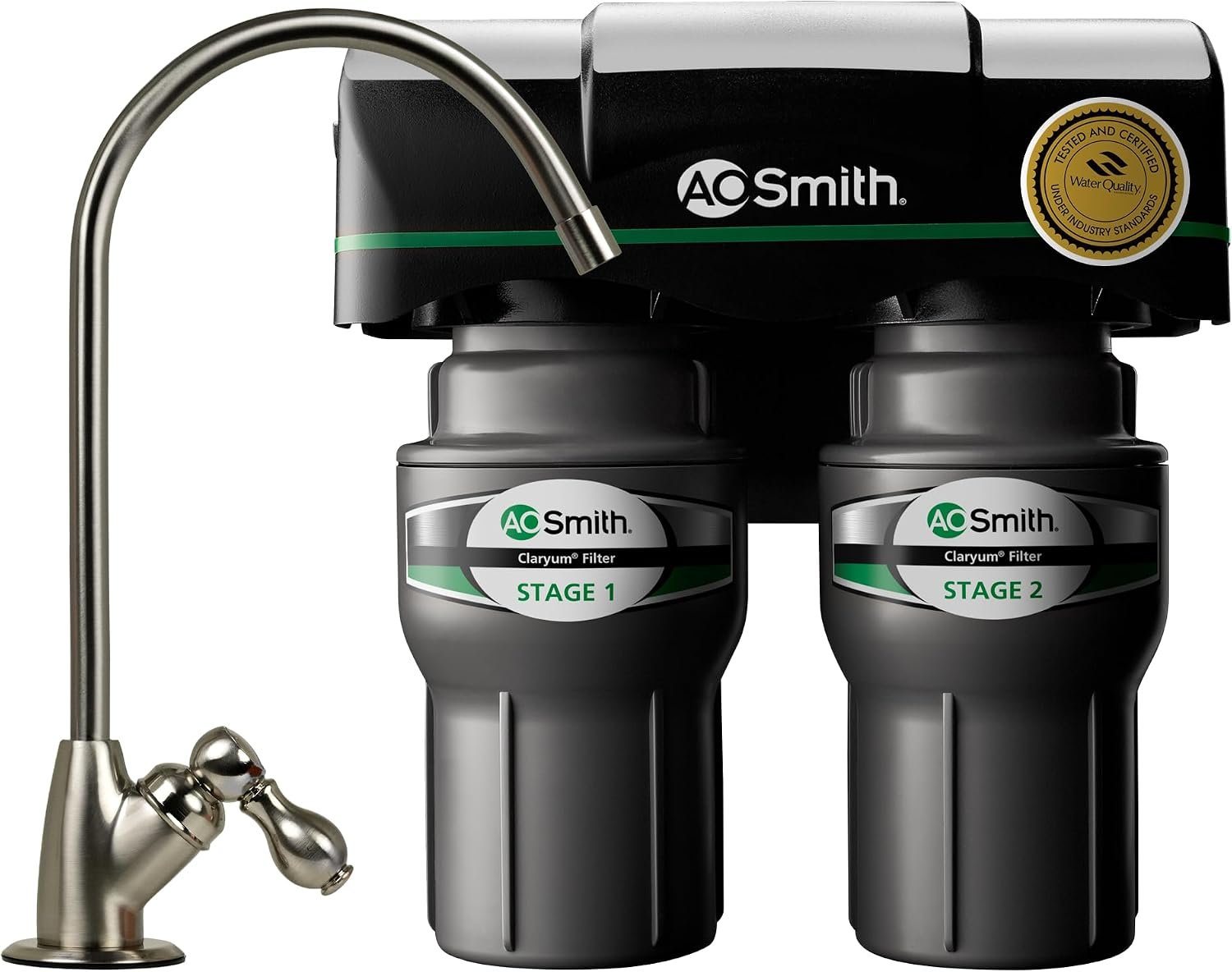
A.O. Smith AO-US-200
2-Stage Claryum · ASIN B07NJ4P99G
Specifications — from the Jun 2025 owner's manual
| AO-US-200 — Performance & Certifications (manual p.6) | |
|---|---|
| Certification | WQA to NSF/ANSI 42, 53, and 401 |
| Rated capacity | 500 gallons / 1,892 liters per filter set |
| Rated flow | 0.5 GPM / 1.89 LPM |
| Operating temp. | 40–90°F (4.44–32.2°C) |
| Operating pressure | 20–80 psi |
| Replacement part | AO-US-200-R (2-pack Claryum cartridges) |
| Replace every | 6 months or 500 gallons, whichever first |
| Filter alarm battery | CR2450 lithium coin (included with AO-US-200-R) |
| Housing replacement | Every 5 years — call 800.821.2017 |
| Faucet hole | ½ in max diameter (or use existing sprayer hole) |
| Wall mount | 7/32 in drill, 2.55 in between holes, 12 in clearance below |
| Tubing insertion depth | 0.95 in — must be complete to prevent leaks |
| TDS reduction | No — not an RO system |
| Warranty | 1 year (12 months from purchase) |
What the triple certification actually covers
The AO-US-200's WQA certification covers three separate NSF/ANSI standards — a broader scope than most carbon filters in this price range, which typically carry only NSF 42.
| Standard | What it covers | AO-US-200 |
|---|---|---|
| NSF/ANSI 42 | Aesthetic effects — chlorine, taste, odor, particulates | Certified |
| NSF/ANSI 53 | Health effects — lead, cysts, VOCs, mercury, asbestos, chloramine | Certified |
| NSF/ANSI 401 | Emerging contaminants — pharmaceuticals, pesticides, PFAS | Certified |
| NSF/ANSI 372 | Lead-free material content in filter parts | Not stated in manual |
NSF 53 is the standard that matters most for documented health concerns — lead pipes in older homes, chloramine from municipal treatment, cysts. The AO-US-200's NSF 53 certification is verified by WQA and listed at WQA.org, not just claimed in marketing copy. The full contaminant reduction list is on A.O. Smith's published Performance Data Sheet.
Certification is system-level, not cartridge-level. The WQA certification applies to the AO-US-200 system as tested with genuine AO-US-200-R cartridges. Third-party compatible filters are different products — the certification does not transfer to them. See the warranty section below.
What's in the box
Everything needed for a complete install — confirmed from the manual's Box Contents page. No hardware store run required.
Installation — what the manual actually requires
A.O. Smith lists the recommended tools and notes that a professional is recommended if pipe cutting or drilling is required. The six-step install from the manual:
Install brass tee on cold water shutoff valve
Turn off cold supply. Disconnect water line. Attach ¼" brass tee to shutoff valve and reconnect cold line to tee. Cold water supply only — 40–90°F, 20–80 psi.
Mount the dedicated faucet
Use an existing sprayer or soap dispenser hole, or drill a hole no more than ½ inch in diameter. Faucet spout must extend past the sink edge. Thread spacer, washer, and nut under the sink to secure.
Mount the filter system to the cabinet wall
Select a location at least 12 inches from the cabinet bottom. Drill two 7/32-inch holes, 2.55 inches apart. Tap in plastic anchors and mount with screws. Pull battery tab — LED flashes red and beeps 5 times to confirm battery installed correctly.
Attach filter sumps
Align connection points, push sump up, turn right until you feel a click. Do not angle sumps — this damages the O-ring. Do not lubricate the O-ring. Hand tighten only — no tools, no over-tightening. Systems purchased before 2024 may not click.
Connect supply lines — critical: insert tubing 0.95 inches
Connect tubing from brass tee to filter inlet; faucet tubing to filter outlet. Wet the tube end for easier seating. Insert tubing fully to 0.95 inches — the manual marks this as VERY IMPORTANT to prevent leaking. Cut excess tubing to prevent kinks.
Flush 10 minutes — do not drink flushed water
Turn on cold supply. Open dedicated faucet. Check for leaks. Run water for 10 minutes or until clear of carbon fines. Check for leaks again while flushing. Do not drink flushed water.
Dishwasher adjacent cabinets: use caution when mounting — the manual warns that screws may exceed cabinet width if the back wall is shared with a dishwasher.
The filter alarm and battery system
A feature that sets the AO-US-200 apart from many under-sink filters at this price point: a built-in battery-powered filter life indicator.
At ~95% filter capacity (~6 months)
Alarm sounds and flashes red while water is flowing. Continues for 15 seconds after flow stops. This is your replacement signal.
Battery: CR2450 lithium coin (3V)
Replace the battery every time you replace the filters. A fresh CR2450 is included with every genuine AO-US-200-R replacement cartridge pack. Follow the manual's battery safety instructions — CR2450 is a coin cell with ingestion hazard.
Confirmed correctly: LED flashes red, beeps 5 times
After installation or battery replacement, pulling the plastic tab should produce 5 flashes and 5 beeps. No response means the battery is not seated correctly.
The third-party filter question
Third-party filters void the warranty and lose certification — both stated in the manual
The Jun 2025 owner's manual states: "This filter system is designed and tested for use with genuine A.O. Smith parts, including replacement filters, faucet and all hardware. Use of parts from other manufacturers may result in loss of contaminant reduction performance, system damage or failure. Use of parts from other manufacturers will also void your warranty."
Several third-party AO-US-200-R compatible filters are available on Amazon at lower prices. Before choosing one, weigh these facts:
| Genuine AO-US-200-R | Third-party compatible | |
|---|---|---|
| WQA certification | Maintained | Lost — different product |
| System warranty | Valid | Voided |
| CR2450 battery included | Yes — per manual | Varies by brand |
| Contaminant reduction | Certified to Performance Data Sheet | Uncertified — manufacturer claim only |
The 5-year housing replacement requirement
The owner's manual includes a requirement most reviews overlook: "Must replace housing every 5 years or risk property damage from leaks." Call 800.821.2017 to order replacement housing. Budget this into the true 5-year ownership cost — filter cartridges alone are not the complete picture.
Pros and cons
Pros
- WQA certified to NSF 42, 53, and 401 — the broadest carbon filter certification at this tier
- NSF 53 covers health contaminants — lead, cysts, chloramine, mercury, asbestos
- NSF 401 covers emerging contaminants including PFAS and pharmaceuticals
- Dedicated brushed-nickel faucet included — no main faucet modification needed
- Battery alarm at ~95% filter life — actual reminder, not just a calendar
- Complete install kit in the box — no separate hardware needed
- Zero-waste filtration — no drain connection, no water wasted
- Wide retail availability — Amazon, Home Depot, Lowe's
Cons
- Requires drilling faucet hole — not renter-friendly unless a spare hole exists
- Third-party filters void warranty and lose certification
- Housing must be replaced every 5 years
- Does not reduce TDS — not an RO system
- 0.5 GPM — noticeably slower than unfiltered tap
- 1-year warranty only
- Do not install near direct sunlight or freezing temperatures
Installation mistakes to avoid
Not inserting tubing the full 0.95 inches
The manual marks this VERY IMPORTANT in bold. Shallow insertion is the leading cause of slow leaks inside a sealed cabinet. Wet the tube end first to ease seating all the way in.
Using tools to tighten sumps
The manual warns in bold: hand tighten only. Over-tightening with tools damages the O-ring and causes leaks.
Installing on a hot water line
Cold water only — 40–90°F. The supply must stay within this range at all times, including in unconditioned spaces that may freeze.
Drinking the initial flush water
The manual says this explicitly: do not drink flushed water. Run 10 minutes until clear before use.
Testing with a TDS meter and assuming a fault
This is not an RO system. TDS will not drop. Use it to confirm the filter is removing contaminants specified on the NSF performance data sheet, not to measure total dissolved solids.
Common questions
Is the A.O. Smith AO-US-200 NSF certified?
Yes — certified by WQA to NSF/ANSI 42 (aesthetic), 53 (health effects including lead and cysts), and 401 (emerging contaminants including PFAS and pharmaceuticals). This is confirmed on the Performance & Certifications page of the Jun 2025 owner's manual and verified at WQA.org.
How often do I replace the filters?
Every 6 months or 500 gallons, whichever comes first. The battery alarm flashes red and sounds at ~95% capacity to prompt replacement. Replace the CR2450 battery at every filter change — it's included with genuine AO-US-200-R cartridges.
Can I use third-party replacement filters?
The manual explicitly warns against it — third-party parts may reduce performance, damage the system, and void the warranty. The WQA certification also applies to the system as tested with genuine AO-US-200-R filters; it does not carry over to third-party cartridges.
Does the AO-US-200 reduce TDS?
No. This is a carbon block filtration system, not reverse osmosis. A TDS meter will show no change — that's expected. If TDS reduction is the goal, you need an RO system.
Does it require drilling?
One hole for the faucet — up to ½ inch diameter. You can use an existing soap dispenser or sprayer hole instead. The filter unit itself mounts to the cabinet wall (two 7/32-inch holes). Not renter-friendly unless a spare sink hole already exists.
Buy the A.O. Smith AO-US-200
System ASIN B07NJ4P99G · Replacement AO-US-200-R ASIN B07PWNK3M4